
You just finished your final exam. Now you are staring at your screen, refreshing the student portal every five minutes. Your mind keeps asking the same question over and over. What will my GPA be after this semester?
I have been there. Every student has been there. The waiting feels endless.
Here is the good news. You do not have to wait for official grades to know where you stand. You can predict your new GPA right now. Before your professor even submits the final scores.
In this guide, I will show you a simple method to calculate exactly what your GPA will become. No complex math. No confusion. Just a straightforward formula, real examples, and a free calculator.
Let me show you how.
What Will My GPA Be After This Semester? (Quick Answer)
Here is the direct answer to your question.
What will my GPA be after this semester depends on three things. Your current GPA and total credits. The grades you expect to earn this term. And how many credit hours you are currently taking.
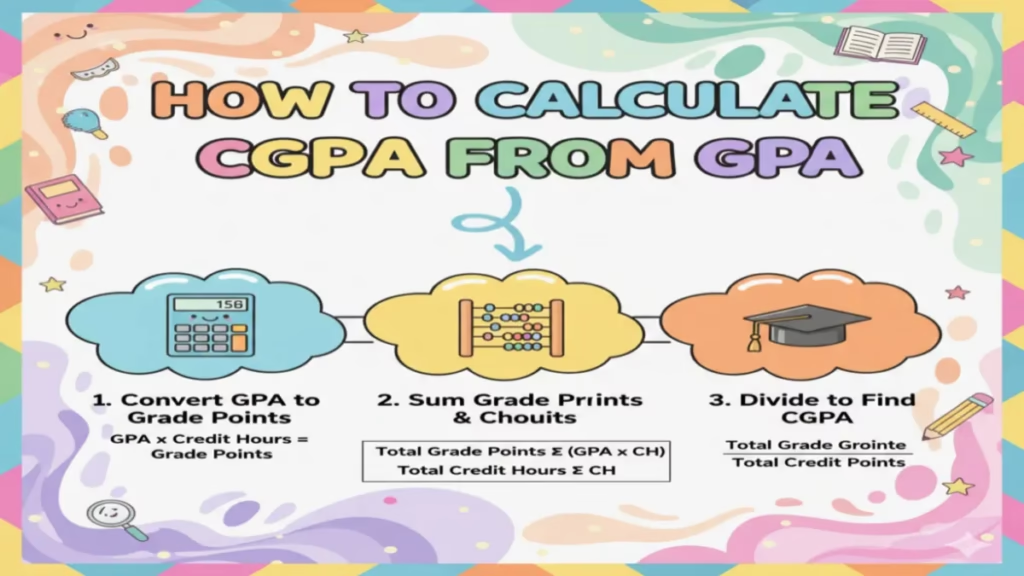
Your new cumulative GPA is simply your old total grade points plus your new semester grade points, divided by your old total credits plus your new semester credits.
Think of it like this. Your old GPA is the average of everything you have done so far. Your new semester grades will either pull that average up, push it down, or leave it unchanged.
If you earn higher grades than your current average, your GPA goes up. If you earn lower grades, your GPA goes down. If you earn exactly your current average, your GPA stays the same.
That is the basic principle. Now let me show you exactly how to calculate it.
Key Factors That Affect Your GPA After This Semester
Think of these factors like ingredients in a recipe. Change one ingredient, and the final dish changes.
Current GPA and Credits
Your starting point matters enormously. A student with a 3.8 GPA needs perfect grades just to stay flat. A student with a 2.0 GPA can raise it significantly with one good semester.
Your current overall GPA vs new overall GPA depends entirely on how many credits you have already earned. More past credits mean less movement.
Grades You Expect This Semester
This is where you have control. Your final grade prediction drives everything. An A helps. A C hurts. Be realistic about what you can actually achieve.
Your estimate semester GPA before grades post should be honest. Overestimating your grades will give you a false sense of security.
Credit Hours in Progress
Why do more credits equal bigger impact? Simple math.
A 3-credit course affects your GPA three times more than a 1-credit course. If you are taking 18 credits, your semester has more weight than someone taking 12 credits. More credits mean more power to move your GPA.
Quality Points Earned
Every letter grade has a point value. A equals 4 quality points per credit. B equals 3. C equals 2. D equals 1. F equals 0.
When you multiply your grade points by credit hours, you get quality points earned. This is the real fuel for your GPA calculation.
Step-by-Step: How to Calculate What My GPA Will Be After This Semester
Follow these six steps. It is simple, like dividing chores among siblings.
Step 1: List All Your Courses
Write down every course you are taking this semester. Include the credit hours for each one.
Step 2: Assign Expected Grades
Next to each course, write the grade you think you will earn. Be honest. Not optimistic. Not pessimistic. Realistic.
Step 3: Convert Grades into GPA Points
Use this scale. A = 4.0. B = 3.0. C = 2.0. D = 1.0. F = 0.0. Add plus and minus adjustments if your school uses them. A- = 3.7. B+ = 3.3.
Step 4: Multiply by Credit Hours
For each course, multiply the grade points by the credit hours. This gives you quality points for that course. Add all of them together. That is your total semester quality points.
Step 5: Add Old + New Quality Points
Find your current total grade points. Multiply your current GPA by your total completed credits. Add your new semester quality points to that number.
Step 6: Divide by Total Credits
Add your old total credits to your new semester credits. Divide the total quality points by this number. That is your new cumulative GPA.
This entire process answers how do I calculate my GPA after this semester perfectly. No guessing. Just simple arithmetic.
Simplifi GPA Calculation Formula
Let me write the formula in plain English.
New GPA = (Old GPA × Old Credits) + (Semester GPA × New Credits) ÷ (Old Credits + New Credits)
Here is an example.
Your old GPA is 3.0 after 60 credits. That gives you 180 total grade points (3.0 × 60).
This semester you take 15 credits and earn a 3.5 GPA. That gives you 52.5 new grade points (3.5 × 15).
Add them together. 180 + 52.5 = 232.5 total grade points. Add your credits. 60 + 15 = 75 total credits. Divide. 232.5 ÷ 75 = 3.1 new GPA.
That is the difference between term GPA vs cumulative GPA. Your term GPA was 3.5. Your cumulative GPA moved from 3.0 to 3.1.
Free GPA Calculator
Why do all this math manually? A grade point average calculator does it instantly.
Our cumulative GPA vs semester GPA calculator is built into the All-in-One Grade Converter. Here is how to use it.
Go to the calculator. Select the “Cumulative GPA” tab. Enter your current GPA and total credits. Then enter your expected semester GPA and credits. Click calculate. Your new GPA appears instantly.
No errors. No manual math. Just accurate results.
Using a tool like this helps you answer what will my gpa be after this semester in seconds. You can run multiple scenarios. What if I get all A’s? What if I get one B? What if my worst grade is a C?
Try it yourself.
📌 Predict your GPA now: Use our All-in-One Grade Converter to get instant results.
Examples
Let me show you how this works with real student situations.
What Will My GPA Be After This Semester College Example
Meet Sarah. She has a 3.0 GPA after 45 credits. This semester she takes 15 credits. She expects two A’s (4.0 each, 6 credits total), two B’s (3.0 each, 6 credits total), and one C (2.0, 3 credits).
Her semester grade points = (4.0×6) + (3.0×6) + (2.0×3) = 24 + 18 + 6 = 48. Semester GPA = 48 ÷ 15 = 3.2.
Her new cumulative GPA = (3.0×45) + (3.2×15) ÷ (45+15) = (135 + 48) ÷ 60 = 183 ÷ 60 = 3.05.
Sarah’s GPA goes up from 3.0 to 3.05. A small but meaningful improvement.
What If I Get All A’s This Semester?
Let us calculate find my GPA if i get all a’s this semester.
Same Sarah, but now she earns all A’s in 15 credits. Semester grade points = 4.0 × 15 = 60. Semester GPA = 4.0.
New cumulative GPA = (135 + 60) ÷ 60 = 195 ÷ 60 = 3.25. That is a 0.25 point jump. Much better.
What If I Get All C’s or Have a Bad Semester?
Now what happens to my cumulative GPA after one bad semester.
Sarah gets all C’s. Semester grade points = 2.0 × 15 = 30. Semester GPA = 2.0.
New cumulative GPA = (135 + 30) ÷ 60 = 165 ÷ 60 = 2.75. Her GPA drops from 3.0 to 2.75. That is significant.
What My GPA Becomes After 5 Classes This Semester
Let us calculate what my gpa becomes after 5 classes this semester. Each class is 3 credits. Total 15 credits.
Grades: A, A-, B+, B, C. Point values: 4.0, 3.7, 3.3, 3.0, 2.0. Total grade points = 4.0+3.7+3.3+3.0+2.0 = 16.0. Semester GPA = 16.0 ÷ 5 = 3.2.
Using the same starting point as Sarah, her new cumulative GPA would be (135 + 48) ÷ 60 = 3.05.
Predicting vs Actual GPA – Reality Check
Projected GPA vs Actual GPA After Semester
Your projected gpa vs actual gpa after semester might differ slightly. Here is why.
Professors grade differently. Some curve. Some do not. Your final exam might be harder or easier than expected. Participation points might surprise you.
But in most cases, your prediction will be very close to reality. The math is exact. Only your grade estimates introduce uncertainty.
Is It Possible to Predict My Exact GPA Before Finals?
Is it possible to predict my exact gpa before finals? Yes and no.
You can calculate the exact number based on your expected grades. But if your actual grades differ, your actual GPA will differ. Update your prediction as you get more information. After midterms. After the final exam. Before grades post.
The closer you are to the end of the semester, the more accurate your prediction becomes.
Will My GPA Go Up or Down After This Semester?
Will my gpa go up or down after this semester depends on one simple comparison.
Compare your expected semester GPA to your current cumulative GPA. If your semester GPA is higher, your overall GPA goes up. If it is lower, your overall GPA goes down. If they are equal, your GPA stays the same.
GPA adjustment is not mysterious. It is just averaging.
Think of it like your average test score. If you score higher than your current average, your average rises. Lower scores drop it. The same logic applies to how grades affect upward or downward movement.
Term GPA vs Cumulative GPA
This confuses many students. Let me clarify.
Your term GPA vs cumulative GPA are two different numbers.
Your term GPA covers only one semester. It resets every term. It tells you how you did in fall or spring.
Your cumulative GPA covers every semester you have ever taken. It never resets. It is your permanent record.
What will my cumulative GPA be after this semester is what most students actually care about. That is the number on your transcript. That is what employers and graduate schools see.
What will my overall GPA be after this semester means the same thing. Your overall GPA is your cumulative GPA.
Your term GPA matters during the semester. Your cumulative GPA matters forever.
Special Academic Situations
Repeat Course GPA Calculation
Many schools have a grade replacement policy. If you fail a course and retake it, the new grade sometimes replaces the old one in your GPA calculation.
Check your university’s policy. Some schools replace the grade entirely. Some average the two attempts. Some keep both but only count the higher one.
For repeat course gpa calculation, you usually only count the most recent attempt. Your old failing grade disappears from the calculation.
Withdraw (Pass vs Fail) Impact
A withdrawal has different impacts depending on timing.
Withdraw passing vs failing GPA impact matters. A “WP” (withdraw passing) usually does not affect your GPA. A “WF” (withdraw failing) often counts as an F, which drops your GPA significantly.
Always check your school’s withdrawal deadline and policy. Dropping a course early is much better than failing it later.
Weighted vs Unweighted GPA After This Term
Weighted gpa vs unweighted gpa after this term applies mostly to high school students.
Unweighted GPA treats all courses equally. An A in gym is worth the same as an A in calculus. Scale is 0 to 4.0.
Weighted GPA gives extra points for advanced courses. AP, IB, or honors classes might give a 5.0 for an A. Scale can go above 4.0.
When calculating your GPA after this semester, know which type your school uses.
Academic Goals & GPA Impact
Your GPA affects many parts of your academic life.
Academic Standing
Academic probation warning triggers when your GPA drops below your school’s minimum (usually 2.0). One bad semester can put you on probation. A second bad semester can get you suspended.
Dean’s List Requirements
Dean’s list GPA requirement at most universities is 3.5 or higher for the semester. Some schools require 3.75. Check your institution’s specific cutoff.
Scholarships & GPA
Scholarship GPA renewal is critical. Most merit scholarships require you to maintain a minimum cumulative GPA. Often 3.0 or 3.5. If your GPA drops below, you could lose funding.
Graduate School Goals
Graduate school GPA cutoff for most master’s programs is 3.0 minimum. Competitive programs expect 3.5 or higher.
Major requirement GPA matters too. Some majors require a minimum GPA to declare the major or to graduate.
How to Raise My GPA by the End of This Semester
You are not stuck with your current GPA. You can improve it before the term ends.
Can I Raise My GPA This Semester?
Yes. Can i raise my gpa by the end of this semester depends on your current credits and your upcoming grades.
The formula is the same. Higher grades than your current average will raise your cumulative GPA. Even a small increase is progress.
How Many A’s Do I Need to Raise My GPA?
How many a’s do i need to raise my gpa this semester depends on your situation. Use the calculator. Enter your numbers. See exactly how many A’s you need to reach your target.
In general, the more credits you take, the fewer A’s you need. Take 18 credits instead of 12. That gives you more power to move your GPA.
Smart Study Strategy Tips
Focus on high-credit courses first. A 4-credit class affects your GPA four times more than a 1-credit lab.
Attend every class. Missing even one lecture puts you behind.
Complete all assignments. A zero on a small assignment hurts as much as a bad exam grade.
Study every day. Two hours daily beats ten hours the night before the final.
Common GPA Prediction Mistakes to Avoid
Avoid these errors.
Ignoring credit hours. Some students average their grades without weighting by credits. That gives a wrong number.
Wrong grade assumptions. Being overly optimistic inflates your prediction. Being overly pessimistic discourages you. Be realistic.
Not including all courses. Every course counts. Even the 1-credit lab. Even the pass/fail elective (though it does not affect GPA, it still appears on your transcript).
FAQs
conclusion
You now know exactly how to answer what will my gpa be after this semester.
The formula is straightforward. Your new GPA is simply a weighted average of your old GPA and your new semester grades.
Your grade point average calculator (whether manual or digital) gives you power. Power to plan. Power to predict. Power to improve.
Here is my advice. Do not wait for grades to post. Calculate your projected GPA now. If it is lower than you want, you still have time to study harder. If it is higher, good for you.
GPA is manageable with strategy. Every semester is a new opportunity. Use the formula. Use the calculator. Set realistic expectations.
And remember. One semester does not define you. Whether your GPA goes up or down, you can always improve next term.
Plan ahead. Study smart. Track your progress.
Your future GPA is in your hands.