
Let me give you the short answer first. Does your GPA change every semester? Yes, it absolutely can. Your GPA updates after each term based on the new grades you earn and how many credit hours those courses carry.
But here is what most students get wrong. There is a big difference between your semester GPA and your cumulative GPA.
Your semester GPA resets to zero every term. It only reflects one period — like fall or spring.
Your cumulative GPA is the one that keeps growing. It adds every semester together. That is the number that actually changes over time.
Think of it this way. Each semester is a new chapter. Your cumulative GPA is the whole book so far.
What Is GPA? (Beginner Explanation)
Let me start with the basics.
GPA stands for Grade Point Average. It is a single number that represents your academic performance.
But here is where students get confused. There are actually two types of GPA.
Semester GPA: This covers only one term. Fall semester has its own GPA. Spring semester has another. Each stands alone.
Cumulative GPA: This adds up every semester you have completed. If you are in your third year, your cumulative GPA includes all six semesters so far.
Let me give you a simple analogy.
Imagine your family gets a monthly budget report. Each month’s report is like your semester GPA. It shows how you did in just that one month.
But your yearly financial summary? That is your cumulative GPA. It adds all twelve months together.
Each semester brings new grades. Each semester can change your cumulative GPA.
Does Your GPA Change Every Semester?
Now let me answer the main question directly.
Yes, your GPA updates after each semester. Every time you finish a term, your school recalculates your cumulative GPA.
Why does it change? Because new grades get added to your academic record. Your old grades stay. Your new grades join them. The average shifts.
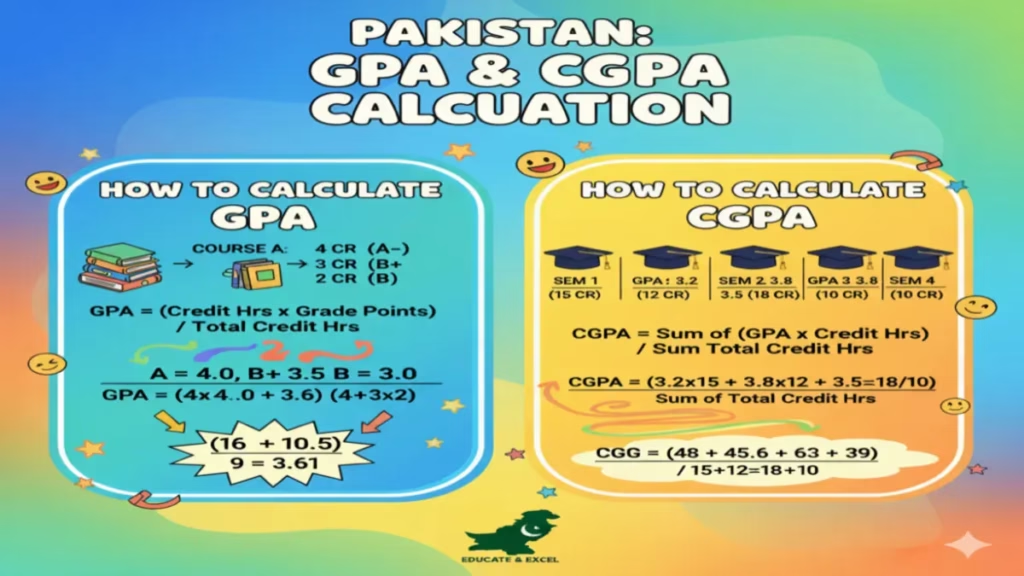
Here is the exact formula your school uses:
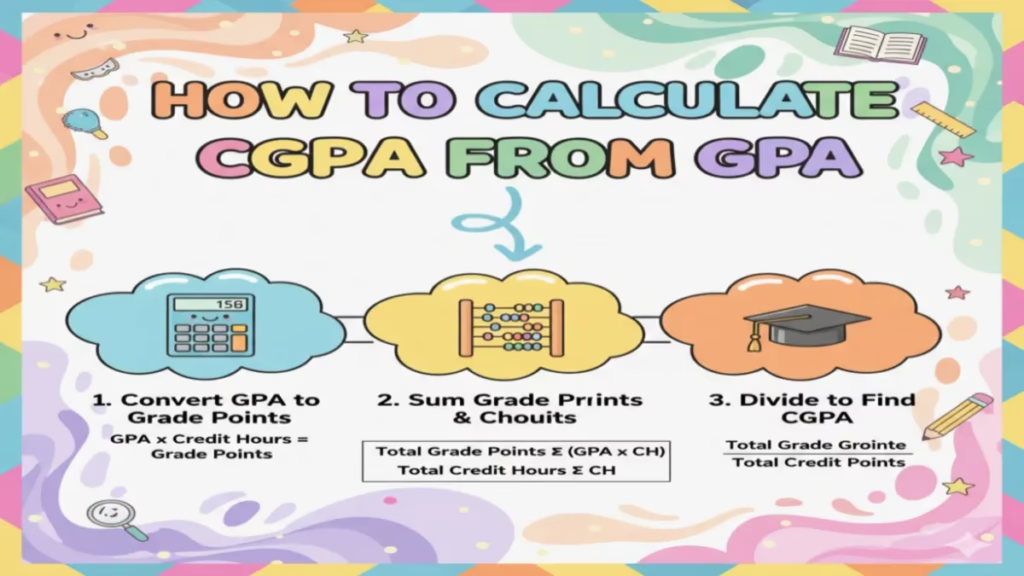
New Cumulative GPA = (Old Total Grade Points + New Semester Grade Points) ÷ (Old Total Credits + New Semester Credits)
Let me give you a real example.
Suppose you have a 3.0 cumulative GPA after 60 credits. That means you have 180 total grade points (3.0 × 60).
Now you take a new semester with 15 credits and earn a 3.5 GPA. That gives you 52.5 new grade points (3.5 × 15).
Your new total grade points = 180 + 52.5 = 232.5
Your new total credits = 60 + 15 = 75
Your new cumulative GPA = 232.5 ÷ 75 = 3.1
Your GPA went up from 3.0 to 3.1. That is how does your gpa change every semester works in real life.
Now, when might your GPA stay exactly the same? That only happens if your new semester GPA equals your old cumulative GPA. It is possible but rare.
Does Your GPA Go Up Every Semester?
Here is the honest answer. No, your GPA does not automatically go up every semester.
It only increases when you earn grades better than your current average.
Let me show you three different scenarios.
- Scenario 1: GPA goes up
Your cumulative GPA is 2.8. You work harder this semester and earn a 3.4. Your new cumulative GPA becomes 2.9 or 3.0 depending on credits. Your GPA increased. - Scenario 2: GPA goes down
Your cumulative GPA is 3.5. You struggle this semester and earn a 2.8. Your new cumulative GPA drops to 3.3 or 3.2. Your GPA decreased. - Scenario 3: GPA stays flat
Your cumulative GPA is 3.2. You earn exactly a 3.2 this semester. Your GPA does not change. It stays the same.
So does your gpa go up every semester? Only if you perform better than your past self. It is not automatic. It requires effort.
Does Your GPA Update Every Semester?
Yes, your school updates your GPA at the end of every term.
Here is the typical timeline.
Final exams finish. Professors submit grades. The registrar processes everything. Within 1 to 3 weeks, your new GPA appears on your transcript.
Most universities use systems like Banner, PeopleSoft, or Moodle. These systems automatically recalculate your cumulative GPA once all grades are entered.
Does your gpa update every semester even if you take a break? Usually yes. If you skip a semester, your GPA stays exactly where it was. No change happens because no new grades were added.
Now a quick note about different academic calendars.
- Semester system: Two terms per year (fall and spring). GPA updates twice annually plus possible summer term.
- Quarter system: Three terms per year (fall, winter, spring). GPA updates three times annually.
- Trimester system: Three terms but different scheduling. Updates three times per year.
No matter the system, your GPA updates after every term when grades are official.
Do Semester Grades Affect GPA?
Absolutely. Every single grade you earn affects your cumulative GPA.
But here is the catch. Not all grades affect your GPA equally.
Credit hours are the key. A course with more credit hours has a bigger impact on your GPA than a course with fewer credits.
Let me show you an example.
| Course | Credits | Grade | Grade Points | Weighted Impact |
|---|---|---|---|---|
| Math | 4 | A (4.0) | 16.0 | High impact |
| English | 2 | A (4.0) | 8.0 | Medium impact |
| Physical Education | 1 | A (4.0) | 4.0 | Low impact |
All three courses got the same A grade. But the 4-credit math course added twice as many grade points as the 2-credit English course. And four times as many as the 1-credit PE class.
So do semester grades affect GPA? Yes. But high-credit courses affect it much more.
Here is what this means for you. If you want to raise your GPA, focus extra effort on your 3 and 4 credit courses. A good grade there matters more than a good grade in a 1-credit lab.
Is GPA Based on Semester or Quarter?
This depends entirely on where you study. Different schools use different academic calendars.
Semester System (Most Common)
About 95% of colleges in the United States, Canada, and Pakistan use semesters. Each academic year has two main terms: fall (August to December) and spring (January to May). Some also offer a shorter summer term.
Your GPA in a semester system is based on approximately 15 weeks of coursework per term.
Quarter System (Less Common but Still Used)
Schools like Stanford, University of Chicago, and many West Coast colleges use quarters. Each academic year has three terms: fall, winter, and spring. Each quarter lasts about 10 weeks.
Students in quarter systems typically take 3 to 4 courses per quarter instead of 4 to 5 per semester.
So is GPA based on semester or quarter? Both exist. Your GPA is calculated based on whatever system your school uses. The formula is the same. Only the timeline differs.
Here is what matters for you. If you transfer from a quarter school to a semester school, your credits and GPA get converted. Quarter credits are multiplied by 0.667 to become semester credits. Your GPA stays the same but the scale adjusts.
How GPA Is Calculated Each Semester
Let me walk you through the simple formula your school uses.
Step 1: Convert every letter grade to grade points.
| Letter Grade | Grade Points |
|---|---|
| A | 4.0 |
| B | 3.0 |
| C | 2.0 |
| D | 1.0 |
| F | 0.0 |
Some schools use plus and minus grades. A- is 3.7. B+ is 3.3. Check your university’s specific scale.
Step 2: Multiply each course’s grade points by its credit hours. This gives you quality points.
Example: Math (3 credits × B = 3.0) = 9 quality points
Step 3: Add all quality points together.
Step 4: Add all credit hours together.
Step 5: Divide total quality points by total credit hours.
That final number is your semester GPA.
Your school then takes this new semester GPA and combines it with all your previous semesters to calculate your updated cumulative GPA.
Why Your GPA Changes (Key Factors)
Several factors cause your GPA to move up or down each semester.
1. Grade Improvement or Decline
This is the most obvious factor. Better grades raise your GPA. Lower grades drop it.
But here is what students do not realize. A single bad grade in a high-credit course can hurt more than three bad grades in low-credit courses.
2. Credit Hours Weight
Remember the math example earlier. A 4-credit course has four times the impact of a 1-credit course.
Focus your energy where it matters most. Study harder for your 4-credit core classes than your 1-credit electives.
3. Repeated Courses
Many universities allow grade replacement. If you fail a course and retake it, the new grade often replaces the old one in your GPA calculation.
This can dramatically change your GPA. A failed F (0.0) replaced by a B (3.0) in a 3-credit course adds 9 grade points to your total.
4. Dropped or Failed Subjects
Withdrawing from a course after the deadline usually gives you a W grade. Most schools do not count W in your GPA. But failing with an F definitely counts as 0.0 grade points.
Always check your school’s withdrawal policy before dropping a course past the deadline.
📌 Want to skip the math? Use our Semester GPA Calculator to get instant results. The calculator defaults to CGPA to Percentage. Just scroll and tap Semester GPA to get started.
Can Your GPA Stay the Same?
It is possible but rare for your GPA to stay exactly the same after a semester.
This happens when your new semester GPA matches your old cumulative GPA perfectly.
Let me give you an example.
Suppose your cumulative GPA is 3.0 after 60 credits (180 total grade points).
You take 15 new credits and earn exactly a 3.0 semester GPA (45 new grade points).
Your new total = 180 + 45 = 225 grade points
Your new total credits = 60 + 15 = 75
Your new cumulative GPA = 225 ÷ 75 = 3.0
No change. Your GPA stayed exactly the same.
In real life, this perfect balance is uncommon. Most semesters will shift your GPA slightly up or slightly down.
How to Improve Your GPA Every Semester
Want to see your GPA go up term after term? Follow these proven strategies.
Focus on High-Credit Subjects First
Look at your course load. Identify which classes have the most credit hours. Those deserve most of your study time.
A B in a 4-credit course (12 grade points) helps your GPA more than an A in a 1-credit course (4 grade points).
Avoid Failing Grades at All Costs
An F gives you zero grade points. But it still adds credit hours to your total. That combination is devastating for your GPA.
A single F in a 3-credit course can drop a 3.0 GPA down to 2.7 or lower depending on your total credits.
Track Your Progress Every Semester
Do not wait until graduation to care about your GPA. Check your cumulative GPA after each term. Know exactly where you stand.
Simple Checklist for a Higher GPA Each Semester:
- Attend every class (showing up is half the battle)
- Complete all assignments on time (even small ones add up)
- Review notes weekly (do not cram before finals)
- Ask for help early (office hours exist for a reason)
- Form study groups (teaching others reinforces your own learning)
Common GPA Mistakes Students Make
Avoid these errors that keep students from improving their GPA.
Ignoring Low-Credit Subjects
Some students think, “This lab is only 1 credit. It does not matter.”
Wrong. Every credit counts. An F in a 1-credit course still adds zero grade points and 1 credit hour to your total. It lowers your GPA just like any other failing grade.
Not Understanding Credit Weight
I have seen students stress for hours over a 1-credit gym class while ignoring a 4-credit math course. That is backwards thinking.
Put your effort where the math says it matters most.
Assuming GPA Always Increases
Your GPA does not automatically go up just because you are taking more classes. It only increases when your new grades are better than your old average.
Every semester requires real effort. Past performance does not guarantee future results.
🧮 New to GPA calculation? Before you understand how GPA changes each semester, you need to know the basics. Read our step-by-step guide on how to calculate semester GPA — with real examples and a simple formula anyone can follow.
FAQs
conclusion
Let me leave you with one simple way to think about your GPA.
Imagine your cumulative GPA is like a family budget. Each semester adds new income and new expenses.
A semester with good grades? That is like earning a bonus. Your overall financial picture improves.
A semester with poor grades? That is like an unexpected expense. Your savings take a hit.
But here is the good news. One bad month does not bankrupt your entire year. And one bad semester does not destroy your academic future.
Your GPA changes every semester because each term brings new results. Some semesters will lift your GPA. Others might drop it. That is normal.
The students who succeed long-term are not the ones who never struggle. They are the ones who stay consistent. They attend class. They complete assignments. They track their progress.
Does your GPA change every semester? Yes. And that is actually a good thing. It means you always have the power to improve it.
Focus on the next semester. One term at a time. Your GPA will follow.