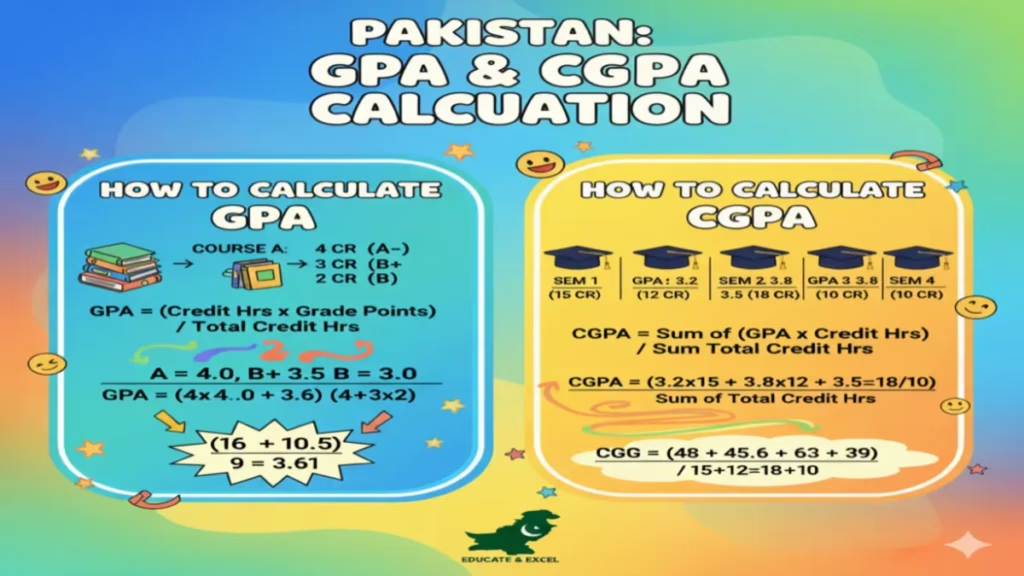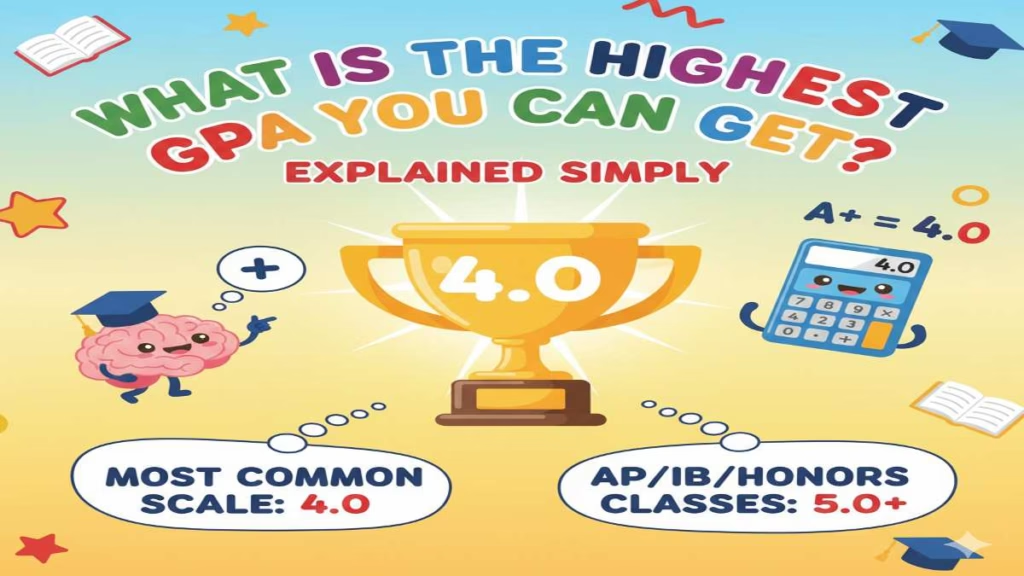
Academic performance is often boiled down to a single number: the Grade Point Average (GPA). This numerical summary is a key metric used by educational institutions worldwide to assess a student’s overall achievement. You might be asking, “what is the highest GPA you can get?” This question is perfectly natural, as students often strive for the best possible score to enhance their college admissions prospects, scholarship eligibility, and overall academic standing.
The complexity in finding a single, definitive answer arises because there are significant variations in the GPA scale. While the traditional scale is capped at 4.0, many high schools employ a weighted system that allows the highest Grade Point Average to exceed this mark, reaching 5.0, 6.0, or even higher, depending on the school’s specific policies. Understanding the difference between weighted and unweighted scales is the first essential step in grasping what the ultimate achievement looks like.
Understanding the Grade Point Average System
The Grade Point Average scoring system is designed to provide a standardized, quantitative measure of a student’s academic success. It converts the letter grades a student earns in their classes into numerical points, which are then averaged across all courses taken. This numerical score offers a quick snapshot of a student’s overall performance, indicating their general proficiency in various subjects.
What is Grade Point Average?
The acronym GPA stands for Grade Point Average. It is a single number that reflects the average of all the grades a student has received over a specific period, such as a single semester, a full academic year, or the entirety of their high school or college career. The way this number is derived is what’s known as the GPA scale.
GPA Scale Overview
Different institutions utilize a variety of GPA scales for calculating academic standing. The most prevalent systems, especially in the United States, are based on a 4.0 scale. However, an overview of grading reveals that others, like the 5.0 or even 10.0 scale, are also in use globally or for specific types of coursework. This variation is why simply asking “what is the highest GPA possible?” can yield multiple answers.
Why Different Institutions Use Different Scales
The reason different educational bodies use varying scales is primarily tied to the type of courses offered and the desire to acknowledge academic rigor.
- The standard GPA scale 4.0 explained is the unweighted system, which gives equal value to every course.
- The weighted system, often represented by the Grade Point Average scale 5.0 meaning or higher, is used to reward students for taking more challenging classes, such as Advanced Placement (AP), International Baccalaureate (IB), or Honors courses. These scales provide a higher Grade Point Average rating for an ‘A’ in an advanced class than in a standard one, giving admissions officers a clearer picture of a student’s capacity for rigorous study.
What Is the Highest GPA You Can Get? (Core Answer)
The answer to “what is the highest GPA you can get” fundamentally depends on the grading system in use. Without considering weighted scales, the maximum GPA you can achieve is a 4.0.
Highest GPA Possible on Common Scales
For a student who earns the equivalent of an ‘A’ in every single class—an exceptional achievement—the maximum score on the two most common scales is:
- Unweighted 4.0 Scale: The highest GPA possible is 4.0. This is the perfect 4.0 GPA, representing straight ‘A’s without any grade-point boost for advanced classes.
- Weighted 5.0 Scale: A student could potentially achieve a perfect 5.0 weighted GPA or even higher, depending on how many weighted courses they take.
Maximum Grade Point Average vs. Highest Weighted GPA Possible
The key distinction is between the raw, unweighted score and the scaled, weighted score.
- The maximum GPA on the traditional 4.0 system is, by definition, 4.0. This max GPA score is often what colleges look at first to establish a baseline of academic performance.
- However, the highest weighted Grade Point Average possible varies widely from school to school. Some schools cap their weighted scale at 5.0, while others assign extra points for every advanced class taken, making theoretical scores of 6.0, 7.0, or even higher a possibility, as evidenced by a few real-life records.
What Grade Point Average Is Considered Perfect?
A perfect GPA score is generally defined by the highest numerical value on the scale used by the institution.
- In a college or university setting using the standard scale, a perfect 4.0 Grade Point Average is the zenith.
- In high schools utilizing advanced weighting, a score of 5.0 or above is often considered the equivalent of a perfect academic record when accounting for course difficulty. Therefore, what Grade Point Average is considered perfect depends on whether you are talking about the unweighted 4.0 GPA or the highest weighted GPA possible at a particular high school.
The Highest GPA by Education Level
The attainable highest GPA changes depending on whether a student is in secondary school or higher education. The most significant difference comes from the use of weighted grades, which are common in high school but rare in college.
High School: Where the Scale Can Stretch
What is the highest GPA you can get in high school often exceeds 4.0, which can be confusing for parents and students new to the system.
The difference lies in the weighted vs unweighted Grade Point Average scale.
- Unweighted GPA: This scale measures your academic performance on a strict 4.0 system. An ‘A’ is always a 4.0, regardless of the class difficulty. The highest achievable unweighted GPA is 4.0.
- Weighted GPA: This scale adds bonus points to grades in rigorous courses, such as AP, IB, and Honors classes. For example, an ‘A’ in an AP course might be worth 5.0 points instead of 4.0.
Because of the weighted system, how high can Grade Point Average go in high school is entirely dependent on the number of advanced classes a student takes and the specific weighting formula of their school district. Scores between 4.5 and 5.5 are common for top-performing students, but as noted, some unique weighting formulas can drive scores much higher. The intent is to show that a student’s commitment to challenging themselves goes above and beyond the standard curriculum.
College / University: A Return to Standardization
What is the highest GPA you can get in college or university Grade Point Average maximum score is almost universally 4.0.
Unlike high schools, most colleges and universities use a strictly unweighted Grade Point Average scale. The rigour of a course is built into the nature of the college curriculum itself and is not typically reflected by an added grade point.
Achieving the college highest Grade Point Average scale of 4.0 requires earning an ‘A’ in every course from freshman year through graduation. This demanding feat of academic consistency is the ultimate goal for students aiming for graduate school or top jobs. The GPA calculation for top scores at this level is straightforward: an average of 4.0 across all credit hours. Students in college and beyond will use their undergraduate GPA as the new benchmark of academic excellence.
A Global Perspective: Highest GPA by Country
Grading systems are not uniform globally. The answer to what is the highest GPA you can get changes dramatically when crossing international borders.
The United States: The Land of Weighted Potential
For those asking what is the highest GPA you can get in America, the answer is a dual one, depending on the educational level.
- High School: The system typically employs a weighted GPA scale in U.S. high schools, which often goes up to 5.0 or 6.0, sometimes even higher. This rewards the selection of difficult classes.
- University: The maximum Grade Point Average in U.S. universities is generally 4.0. Some institutions may have a 4.3 or 4.33 scale where an A+ is awarded 4.3 points, but 4.0 remains the most common highest GPA you can earn.
Canada: A Neighbor with a Slight Twist
In Canada, the grading systems are also varied, and there is no single national standard. The question what is the highest GPA you can get in Canada often leads to two primary scales.
The explanation of Canadian 4.0 and 4.33 scales clarifies the difference:
- 4.0 Scale: Many Canadian universities, like the University of Toronto, use a 4.0 scale where the top grade is 4.0.
- 4.33 Scale: Other institutions, such as the University of British Columbia, use a 4.33 scale, which allows an A+ grade to surpass the traditional 4.0 maximum. This provides a slightly higher Grade Point Average grading scale for extraordinary performance.
Highest GPA at Top Universities
Selective universities, despite their demanding entrance requirements, tend to simplify their academic grading once students are enrolled.
Harvard University: Excellence on a 4.0 Scale
What is the highest GPA you can get at Harvard? Like most U.S. universities, Harvard operates on an unweighted 4.0 scale.
Therefore, the maximum GPA score here is a 4.0. Harvard’s GPA grading policies are strict, and they do not weight grades for more difficult courses. However, it’s crucial to understand that admissions officers at elite schools like Harvard are experts at contextualizing grades. They receive profiles from thousands of high schools with different weighting systems. They will often recalculate applicants’ GPAs onto a standard 4.0 scale to compare them fairly. So, while they might see an applicant with a 4.6 from their high school, they understand that this reflects a weighted scale and will evaluate it accordingly.
Weighted vs. Unweighted Grade Point Average: A Detailed Comparison
The confusion surrounding highest GPA almost always comes back to the difference between these two calculation methods. To fully understand how GPA scale works, one must grasp the distinction.
Definition of Unweighted 4.0 Scale
The definition of unweighted 4.0 scale is a straightforward method where every grade, regardless of the course’s difficulty, is assigned a standard point value. An A is 4.0, a B is 3.0, a C is 2.0, and so on. This scale is used by nearly all colleges and universities for their own grading, and it provides a simple, objective measure of performance.
Definition of Weighted GPA Scale (5.0 or Higher)
The definition of weighted Grade Point Average scale (which can be 5.0 or higher) is an adjusted calculation that gives added points to grades earned in classes designated as being more challenging, such as AP, IB, or Honors courses. The purpose is to recognise and reward the effort involved in taking a more rigorous academic path. This is how a student achieves a highest weighted GPA possible that surpasses 4.0.
Example Calculation: How to Calculate Highest Grade Point Average
Let’s look at an example calculation: how to calculate highest GPA for a student taking five courses.
| Course | Unweighted Grade Point | Weighted Grade Point (5.0 scale) |
| Standard History (A) | 4.0 | 4.0 |
| Standard English (A) | 4.0 | 4.0 |
| AP Calculus (A) | 4.0 | 5.0 |
| Honors Science (A) | 4.0 | 5.0 |
| Standard Art (A) | 4.0 | 4.0 |
| Total Points | 20.0 | 22.0 |
| GPA (Total / 5) | 4.0 | 4.4 |
In this scenario, the student’s unweighted perfect 4.0 GPA remains 4.0, while their weighted GPA climbs to 4.4. This clearly illustrates why some high school transcripts feature a highest GPA students can get that is significantly above the traditional maximum.
Real-Life Records
While the mathematical maximum for an unweighted scale is 4.0, the world of weighted GPAs has produced some astonishing figures.
Highest GPA Ever in the World
The highest GPA ever in the world is difficult, if not impossible, to definitively confirm globally due to the vast differences in grading systems between countries and even between schools within the same country. However, in the United States, students have achieved weighted GPAs well beyond the 5.0 maximum. Reports have surfaced of students graduating with weighted GPAs as high as 11.84. These extreme outliers are almost always the result of school policies that allow students to accrue a massive number of extra points by taking an extraordinary volume of advanced, weighted courses. When colleges evaluate these transcripts, they almost always recalculate the GPA on their own unweighted 4.0 scale to maintain an objective comparison across applicants.
Lowest GPA Ever (For Comparison & Informational Intent)
For completeness, and to provide context for the entire GPA grading scale, the Lowest GPA ever is 0.0, which signifies that a student has failed every class with a failing grade equivalent to zero grade points. This information is included for informational intent and serves as the stark opposite end of the spectrum from the what is a perfect GPA score goal.
How to Achieve the Highest GPA
For students aspiring to the highest echelons of academic performance, achieving a maximum Grade Point Average in school involves more than just studying hard. It requires a strategic approach to coursework and consistent effort. This section offers guidance on how to achieve the highest GPA.
Study Strategies
To maintain the excellent grades required for a top score, effective study habits are crucial. These include:
- Active Learning: Don’t just read notes; summarise, teach the material to others, and create flashcards.
- Time Management: Utilize an organized schedule to balance class time, homework, study, and rest.
- Consistency: Reviewing material briefly every day is far more effective than cramming before an exam.
Taking Weighted Courses (AP, IB, Honors)
The fastest and most strategic way to achieve the highest GPA you can get weighted is to load your schedule with advanced courses. These classes, which include AP (Advanced Placement), IB (International Baccalaureate), and Honors classes, are the only way to earn those extra grade points that push a GPA past 4.0. College admissions officers view the selection of these courses as a strong indicator of a student’s willingness to embrace academic challenge.
Tips for Maintaining a Perfect GPA
Maintaining a perfect GPA score demands intense focus and resilience.
- Prioritize Sleep and Health: Academic burnout is a real threat to consistent high performance.
- Seek Help Immediately: If you are struggling, talk to your teacher or tutor immediately. Do not wait for a minor issue to become a failing grade.
- Focus on Understanding: The goal of understanding GPA grading scale and then using it to your advantage is about deep learning, not just passing tests. Genuine comprehension is the key to sustained success.
What’s the Top GPA Score Students Can Realistically Achieve?
While weighted GPAs can theoretically soar, the top GPA score students can realistically achieve in a standard high school setting that offers a good selection of AP and Honors classes is usually in the 4.5 to 5.0 range. This range is the product of taking a challenging course load and performing exceptionally well in all of them. These are the highest GPA students can get in a typical system that colleges will consider to be truly stellar.
Common Myths & Misconceptions
The varied nature of grading systems has led to a number of persistent myths that can confuse students and parents alike about highest GPA.
Myth: 4.0 is Always the Maximum
This is the most common misconception. As established, while the unweighted maximum is 4.0, the weighted system used in high schools offers a path to a highest GPA you can earn that is significantly higher. The confusion is understandable because the Grade Point Average scale 4.0 explained is the standard and most globally recognised scale.
Myth: Weighted GPA is Accepted Everywhere
A weighted GPA is a calculation method specific to the institution that granted it. When applying to college, a student’s weighted GPA is certainly considered and valued, but it is often not the final score used for comparison. Colleges frequently recalculate all applicants’ GPAs to a standardized, unweighted 4.0 scale to ensure fair comparison between students from different schools with different weighting policies.
Clarifying How Institutions Evaluate GPA Differences
Institutions are highly sophisticated at evaluating transcripts. They do not just look at the final number. They look at the context, the course names, and the school’s profile. They are focused on the quality of classes taken and the grades achieved in them—the GPA calculation for top scores—rather than a single, potentially inflated, weighted number.
Conclusion
The question “what is the highest Grade Point Average you can get” has a complex answer that is far from a simple number. It depends entirely on the grading system in place.
To summarize the highest GPA across different systems: the unweighted maximum is 4.0, which is also the gold standard for most university GPA maximum score systems. However, on a weighted high school scale, a score in the 5.0 range or even higher is the highest weighted GPA possible, reflecting a commitment to academic challenge.
Ultimately, understanding the difference between weighted and unweighted GPA helps maximize academic performance. Whether you are aiming for a perfect 4.0 GPA or the highest weighted Grade Point Average possible, the core takeaway remains: academic success is measured by the quality of your work in the most rigorous classes you can manage, not just the single number on your transcript.
You can find more details about a student who achieved an extremely high weighted GPA in this video. Gaither High School senior Dylan Mazard posts a record-breaking 11.84 GPA
Frequently Asked Questions (FAQs)
Your Comprehensive GPA and CGPA Guide
If you’re looking to master your academic metrics, this collection of articles provides all the essential information you need, from calculating your scores to understanding what they mean for your future. We’ve structured these guides to help you navigate the process clearly, ensuring you have a solid understanding of your academic performance.
Start with the Basics
To begin, you should know exactly how to calculate your Grade Point Average for a single semester. This is the foundational skill required for tracking your performance in real-time.
Calculate Your Overall Score
Once you have your semester GPA figured out, the next logical step is learning how to calculate your Cumulative Grade Point Average (CGPA). This is your overall academic average and the metric most universities and employers look at.
Understanding Conversions
Many applications require your GPA to be submitted as a percentage. If you need a high-level conversion, find out how to convert 3.7 GPA to percentage with our detailed guide. For a more common average, we also walk you through the process of taking a 3 GPA to percentage effortlessly.
Conceptual Clarity
Finally, after mastering the calculations and conversions, you might wonder about the relative merit of each score. Check out our detailed analysis to understand which is better: CGPA or Percentage in various academic and professional contexts.