Keeping track of your academic score in college or university is crucial. The Overall CGPA is the single most important number that summarizes your entire degree’s performance. Understanding how to calculate overall CGPA of all semesters empowers you to take control of your academic journey.
It helps you set goals, identify areas for improvement, and accurately represent your achievements for further studies or jobs. This guide will walk you through everything you need to know, from basic formulas to advanced conversion techniques, in simple, easy-to-follow steps.
What is Overall CGPA and Why is It Important?
The Overall CGPA stands for the Cumulative Grade Point Average. It is a weighted average of the Grade Points earned in all courses completed across all your academic semesters. Think of it as your total academic report card summarized into one score. It reflects your consistent performance over your entire study period, not just a single term.
Why is this score so important?
- Higher Education: Universities use your overall CGPA calculation for students as a major criterion for admission into Master’s or PhD programs. A strong CGPA can open doors to top institutions globally.
- Job Market: Many companies, especially during campus placements, use the CGPA as a primary filter for shortlisting candidates. It signals diligence and capability to potential employers.
- Scholarships and Awards: A high CGPA is often a mandatory requirement for securing academic scholarships, fellowships, and various institutional awards.
- Self-Assessment: Knowing your CGPA helps you track your academic health. It allows you to identify areas for improvement and set realistic academic goals. Furthermore, it gives you insight into your cumulative grade point average status for future planning.
CGPA Grading Standards: Understanding the Basics
CGPA is calculated based on a grading system that converts letter grades (like A, B, C) into numerical Grade Points. These standards can vary between universities and countries, so it’s vital to check your institution’s specific rules. Typically, the scale is out of 10.
Common Grade Point Structure (Example):
- Outstanding (O) / A+: 10 Grade Points
- Excellent (E) / A: 9 Grade Points
- Very Good (VG) / B+: 8 Grade Points
- Good (G) / B: 7 Grade Points
- Average (Av) / C: 6 Grade Points
- Pass (P) / D: 5 Grade Points
- Fail (F): 0 Grade Points
The Grade Point you earn for a subject is multiplied by the Credit Hours (or Credits) assigned to that subject. These credits represent the course’s weight or intensity. The CGPA calculation uses these weighted points. This standardized system ensures fairness when comparing student performance.
Features of Modern CGPA Calculation Tools
Modern technology has made the process of figuring out your academic score much easier. There are now numerous CGPA calculator for all semesters tools available online. These tools provide instant, accurate, and error-free results, saving students valuable time and effort. They help you quickly calculate cumulative grade point average without complex manual work.
Key Features of Advanced Calculators:
- Multi-Semester Input: These tools allow you to input data from all completed semesters at once. This simplifies the process for overall CGPA calculation for students.
- SGPA Integration: You can often input your Semester Grade Point Averages (SGPAs) and their corresponding total credits. The tool then automatically handles the SGPA to Overall CGPA Conversion.
- Custom Grading Scales: Many advanced calculators let you select your specific university’s grading scale (e.g., 4-point, 5-point, or 10-point scale).
- Target Setting: Some tools allow students to set a target CGPA. They then show what grades are needed in future semesters to achieve that goal.
- Error Reduction: By automating the arithmetic, these digital aids drastically reduce the chance of manual calculation errors. Finding a reliable cumulative CGPA calculator online is highly recommended.
Step-by-Step Process to Calculate Overall CGPA
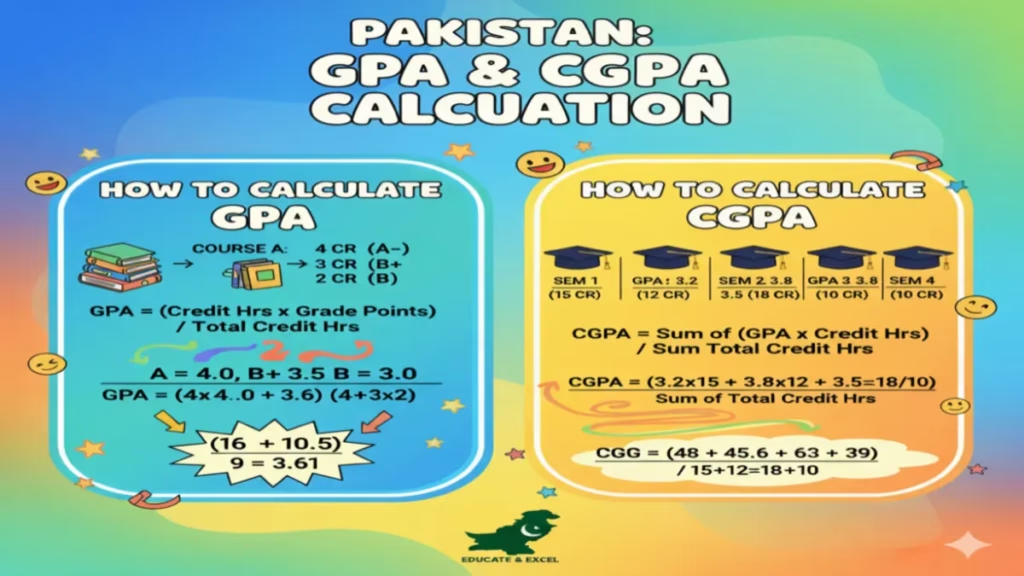
How to find overall CGPA from semester GPA? Calculating your overall CGPA requires a systematic approach. It involves a simple yet essential formula that combines your performance across all terms. Follow these steps to correctly calculate cumulative grade point average.
Step 1: Determine Grade Points and Credits for Each Semester
- For every course in a semester, find the Grade Points awarded (e.g., 9 for an ‘A’).
- Identify the Credit Hours (C) for that specific course.
- Calculate the Grade Point * Credit Hours product for each subject.
Step 2: Calculate the Semester Grade Point Average (SGPA)
- Sum up all the (Grade Points × Credit Hours) products for all subjects in a semester. This gives you the Total Semester Grade Points (TSGP).
- Sum up the total Credit Hours (TC) for that same semester.
- SGPA = Total Credit Hours (TC)Total Semester Grade Points (TSGP)
Step 3: Calculate the Cumulative Grade Point Average (CGPA)
- This is the final and most important step for the overall CGPA calculation method.
- Sum up the Total Semester Grade Points (TSGP) from all completed semesters.
- Sum up the Total Credit Hours (TC) from all completed semesters.
- Overall CGPA = Sum of TC of all semestersSum of TSGP of all semesters
This step-by-step method shows you precisely how to calculate final CGPA in university.
Advanced Calculation Methods and Conversion Techniques
Sometimes, you might need to convert your CGPA to a different format, such as a percentage, or calculate it using an alternative method. These advanced techniques help you compare your performance across different systems. Understanding these can be beneficial when applying for jobs or higher studies that use a different metric.
SGPA to Overall CGPA Conversion
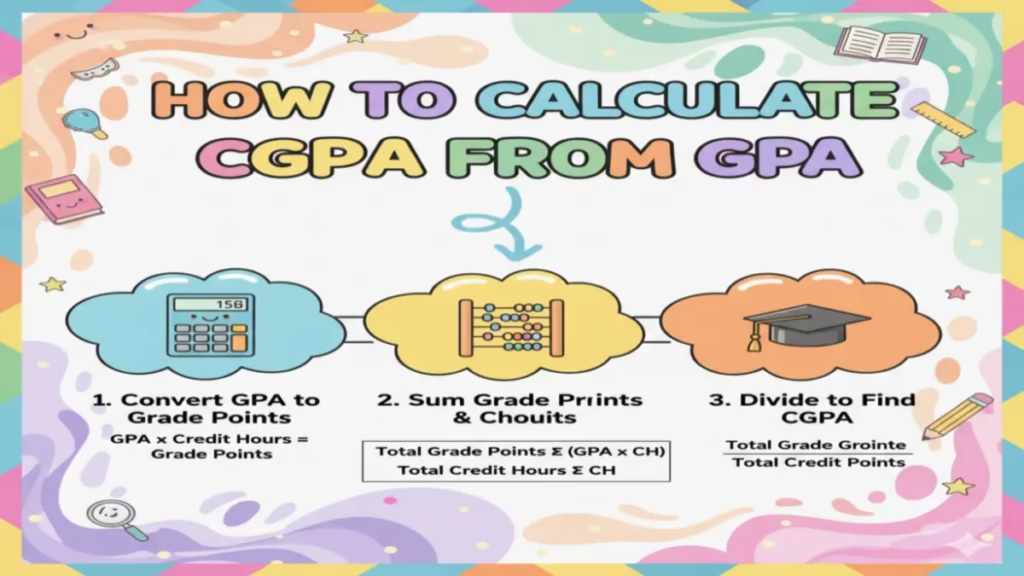
If you already know the SGPA and Total Credits (TC) for each semester, the process becomes simpler. You don’t need to go back to individual subject grades. This is an efficient method to calculate total CGPA from SGPA values.
Formula for Conversion:
- Calculate Total Weighted Points (TWP) for each semester: TWP=SGPA×Total Credits (TC) for that semester.
- Sum up all TWP: Total Weighted Points of all semesters.
- Sum up all TC: Total Credits of all semesters.
- Overall CGPA = Sum of TC of all semestersSum of TWP of all semesters
This technique is a faster way to calculate total CGPA from SGPA values and is frequently used by students.
Percentage Conversion Methods
Universities often provide a direct formula for converting CGPA to an equivalent percentage. It is crucial to use the specific formula provided by your institution, as a universal formula does not exist. However, the most commonly used, and widely accepted, simple conversion formula is the multiplication by 9.5 method.
Common Percentage Conversion (UGC/AICTE Recommended):
- Percentage (%)=Overall CGPA×9.5
For example, an Overall CGPA of 8.0 would translate to 8.0×9.5=76%. Always confirm the official conversion formula on your university’s website or official documents. This ensures you can accurately calculate percentage from overall CGPA.
Grade Point to Division Classification
Your final overall CGPA often corresponds to a specific academic Division or Class. This classification is printed on your degree certificate and is highly regarded by employers and other universities. The classification standards vary but generally follow a structure.
Typical Division Classification (Example):
- First Division with Distinction/Honours: Often CGPA≥8.5 or a similar high threshold.
- First Division: Typically CGPA≥6.5 or 7.0.
- Second Division: Generally CGPA between 5.5 and 6.5.
- Pass/Third Division: Usually CGPA just above the minimum passing criteria (e.g., 5.0).
Check your university’s academic ordinances to know the precise CGPA range for each division. This gives you a clear goal when calculating your final score.
Conclusion
Mastering how to calculate overall CGPA of all semesters is an essential skill for every student. This single score will follow you long after graduation, influencing your career and academic journey. By understanding the CGPA calculation formula, utilizing a reliable CGPA calculator for all semesters, and following the simple step-by-step process, you can confidently track your academic performance. Start today, maintain your scores, and ensure your university CGPA calculation guide always leads to success.
Frequently Asked Questions
Understanding the nuances of the CGPA system can sometimes be confusing. Here are answers to the most common questions students have about their overall academic score.