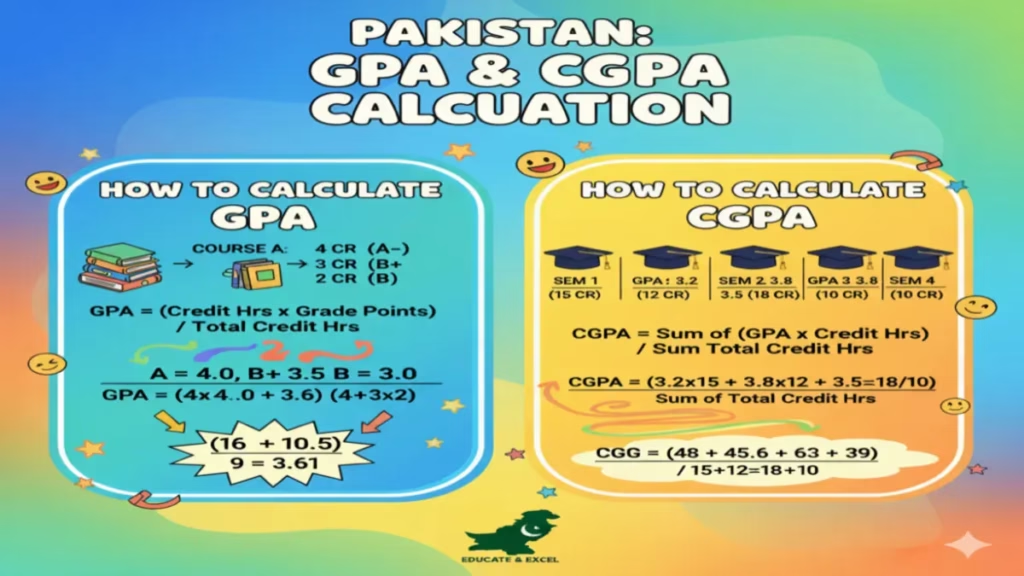
The Grade Point Average (GPA) system is now key in Pakistan’s educational landscape. It offers a standardized way to measure a student’s performance beyond simple percentages. This system is crucial, moving from school to university and later for job applications. Therefore, understanding your GPA is very important for academic and career growth. This detailed guide will clearly explain how to calculate GPA from marks in Pakistan. We will make this complex process easy for every Pakistani student. We will use simple language and provide a step-by-step formula.
What is GPA and Why It Matters: Explanation of GPA
GPA stands for Grade Point Average. It is a single, numerical figure representing your average performance in all your courses over a single semester or term. Think of it as your academic snapshot for that period. The most common GPA scale in Pakistan’s higher education is the 4.0 GPA scale Pakistan.
Your grades (like A, B, C) are first converted into ‘Grade Points’ (like 4.0, 3.0, 2.0). These points are then averaged out, based on the ‘credit hours’ of each course, to get your GPA. This method gives more weight to courses that require more work.
Difference Between GPA and Percentage Marks
The main difference lies in how they reflect performance. Percentage marks show the ratio of marks obtained to total marks. It is a straight calculation. Conversely, GPA is a weighted average that factors in the course load, or ‘credit hours’.
Furthermore, percentage marks are often absolute. The GPA grading system Pakistan is relative to a defined point scale, typically 4.0. Both methods assess performance, but the GPA system is preferred by many universities and international bodies for its consistency and detail.
Importance of GPA for University Admissions and Scholarships
In Pakistan, your GPA (or equivalent percentage) is the single most critical factor for university admissions, especially at the undergraduate level. It acts as the primary filter to shortlist candidates. For scholarships, a high GPA is often a non-negotiable eligibility criterion, but other factors like financial need, entry test scores, and extracurricular activities become increasingly important.
Part 1: Importance for University Admissions
1. The Primary Filter
- Shortlisting: With thousands of applicants for a limited number of seats, universities use GPA as an objective and efficient way to create an initial shortlist. If you don’t meet the minimum GPA/Cut-off percentage (often 50-60% for most programs, but much higher for competitive fields), your application may not even be considered further.
- Merit Lists: Public sector universities, in particular, heavily rely on a Merit Formula where your GPA/percentage is given the highest weightage. A typical formula for undergraduate admissions is:
- Matric (SSC): 10%
- Intermediate (HSSC): 40%
- University Admission Test: 50%
This shows that your pre-university academic performance alone constitutes 50% of your entire admission merit.
2. Variation by University and Program
- Top-Tier Universities: Institutions like LUMS, IBA, NUST, FAST, UET, and Punjab / Quaid-e-Azam University have extremely high GPA expectations. For their competitive programs (e.g., Computer Science, Engineering, Business), the effective cut-off can be 85% and above in Intermediate.
- Less Competitive Universities/Programs: For newer private universities or less sought-after programs (like certain Arts or Humanities fields), the GPA requirement may be more relaxed, focusing on just meeting the minimum criteria.
- Graduate Admissions (MS/MPhil/PhD): While your undergraduate GPA (or CGPA) remains crucial, other factors like research experience, statement of purpose, letters of recommendation, and the GAT (General/GRE Subject) test score gain significant weight. A high GPA is still expected, especially for funding.
3. The “Safe Zone” and Competition
A high GPA (e.g., A/A+ grades or 85%+) places you in a “safe zone” for most programs. It ensures your application is taken seriously. However, due to intense competition, a high GPA alone is no longer a guarantee. A candidate with an 80% and a stellar admission test score can easily outperform a candidate with 85% and a poor test score.
Part 2: Importance for Scholarships
For scholarships, the role of GPA is multifaceted and can be broken down into three main types:
1. Merit-Based Scholarships
These are awarded purely on academic excellence.
- High GPA as the Gatekeeper: Almost all merit-based scholarships have a minimum GPA requirement, which is typically very high (e.g., 3.5/4.0 CGPA or 85%+).
- Automatic Awards: Many universities (especially private ones like LUMS, IBA, FAST) offer automatic tuition fee waivers (25%, 50%, 100%) based on your academic performance in the admission merit list. Your HSSC GPA and admission test score directly determine the level of scholarship you receive upon entry.
- In-Semester Scholarships: Once you are enrolled, you must maintain a high Term GPA or Cumulative GPA (CGPA) to retain your scholarship. There is usually a minimum CGPA (e.g., 3.0 or 3.3) that you must sustain to continue receiving the funding.
2. Need-Based Scholarships
These are awarded based on a student’s financial circumstances.
- GPA as an Eligibility Hurdle: Here, the GPA is not the primary award criterion, but it acts as a qualifying filter. You must demonstrate financial need, but you are also required to maintain a satisfactory academic record (e.g., a CGPA of 2.5 or above) to be eligible and to continue receiving the aid.
3. Government and External Scholarships
Programs like the HEC Need-Based Scholarship, PEEF, and provincial government scholarships.
- Strict Cut-offs: These scholarships have very strict GPA-based eligibility. For example, PEEF often requires a minimum of 60% marks for undergraduates and 70% for graduates, but the actual selection is highly competitive, favoring those with scores above 80%.
- Combination of Merit and Need: They typically use a hybrid model where you must have a high GPA and demonstrate financial need.
The Holistic View: What Else Matters?
While GPA is paramount, it is not the only factor. A strong application is well-rounded:
- Admission Test Score: For many programs, this is the second most important factor, sometimes carrying equal or more weight than your HSSC marks.
- Personal Statement/Interview: Especially crucial for universities like LUMS and IBA, and for graduate admissions. This is your chance to explain any inconsistencies in your GPA and showcase your passion and personality.
- Extracurricular Activities (ECs): Leadership roles, sports, debates, and community service can distinguish you from other candidates with similar GPAs. They are vital for scholarships that look for “all-rounders.”
- Letters of Recommendation: Important for graduate admissions and some competitive undergraduate programs.
Key Takeaways and Advice
- Prioritize Your Grades: Your GPA, especially in Matric and Intermediate, is the foundation of your university application in Pakistan. Do not neglect it.
- Know Your Target: Research the specific merit formulas and GPA cut-offs for the universities and programs you are interested in.
- A Low GPA is Not Always the End: If your GPA is lower than desired, you can compensate with an exceptional admission test score, a powerful personal statement, and strong extracurricular achievements.
- Maintain Consistency: For scholarships, your performance during your degree (your CGPA) is just as important as your performance to get in.
GPA Grading System in Pakistan: Grading Scale (A+, A, B, C, D, F)
Pakistani universities, following the HEC guidelines, use a letter grading system. This system assigns letters from A to F based on the percentage of marks obtained in a course. Here is a typical breakdown, although some universities may have minor differences:
- A Grade: Excellent performance, usually for marks 85% and above.
- B Grade: Good performance, typically for marks between 71% and 84%.
- C Grade: Satisfactory performance, for marks roughly between 61% and 70%.
- D Grade: Minimum passing grade, often for marks 50% to 60%.
- F Grade: Fail, for marks below 50%.
These letter grades are the foundation for the marks to GPA conversion.
GPA Points Chart Used by HEC and Universities
The Higher Education Commission (HEC) and most Pakistani universities primarily use a 4.0 scale for grading. Each letter grade corresponds to a specific numerical ‘Grade Point’. The official HEC GPA calculation method and the points chart are essential for accuracy.
| Letter Grade | % Marks Range | Grade Point |
| A+ | 90 – 100 | 4.00 |
| A | 85 – 89 | 4.00 |
| A- | 80 – 84 | 3.70 |
| B+ | 75 – 79 | 3.30 |
| B | 71 – 74 | 3.00 |
| B- | 68 – 70 | 2.70 |
| C+ | 64 – 67 | 2.30 |
| C | 61 – 63 | 2.00 |
| C- | 58 – 60 | 1.70 |
| D | 50 – 57 | 1.00 |
| F | Below 50 | 0.00 |
Note: The exact percentage ranges may vary slightly between universities.
Comparison of GPA System in Schools, Colleges, and Universities
The GPA scale in Pakistan is primarily used in universities and professional degree programs. Schools and intermediate colleges often still rely on the traditional percentage system.
However, the conversion process becomes critical when a student applies for a bachelor’s program after intermediate. Universities take the intermediate percentage and convert it into a GPA equivalent for admission merit calculation. For most degree programs, the semester-based GPA system (SGPA and CGPA) takes over from the very first semester.
Formula to Calculate GPA from Marks
Learning the exact formula is the best way to understand how GPA is calculated in Pakistan. The process is not complicated once you break it down into simple steps.
Step-by-step Formula: Marks → Grade → Grade Point → GPA
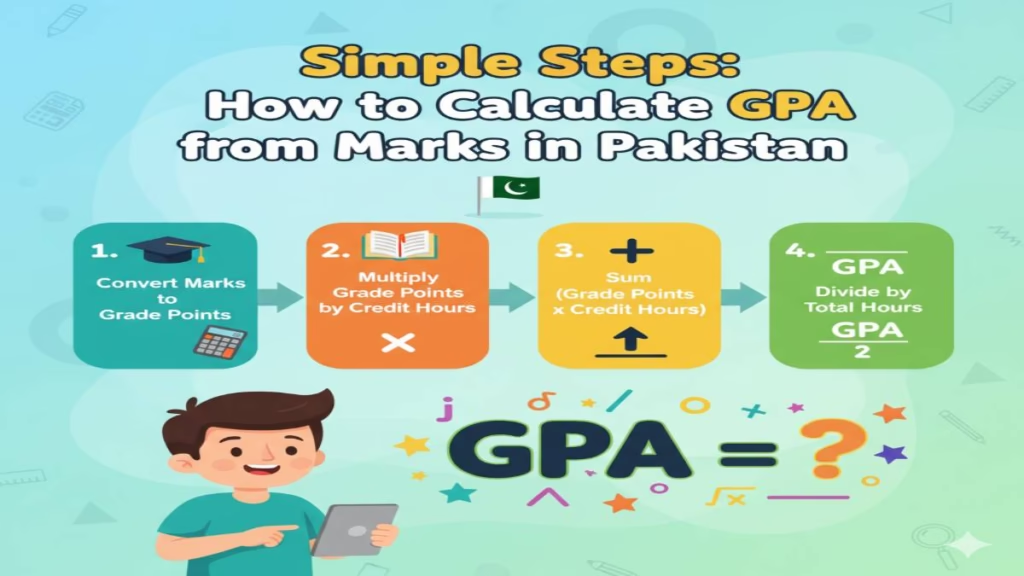
To accurately calculate GPA from marks in Pakistan, follow these simple steps for each course you take in a semester:
- Marks to Letter Grade Conversion: First, determine the total percentage marks you got in a course. Then, check the university’s grading table (like the one above) to find the corresponding Letter Grade (A, B+, C, etc.).
- Letter Grade to Grade Point: Next, look up the Grade Point for that Letter Grade. For example, a ‘B’ grade usually corresponds to 3.00 Grade Points (this is the marks to grade point conversion Pakistan).
- Calculate Quality Points: Multiply the Grade Point by the Credit Hours of that specific course. This gives you the ‘Quality Points’ for that course. Quality Points = Grade Point x Course Credit Hours
- Calculate Semester GPA (SGPA): To find your SGPA for the semester, sum up the Quality Points for all courses and divide that total by the sum of all Credit Hours taken in that semester.

Example Calculation for Better Understanding
Let us look at a simple GPA calculation example Pakistan for a single semester with three courses:
| Course | Credit Hours | % Marks | Letter Grade | Grade Point | Quality Points (GP × CH) |
| Math | 3 | 82% | A- | 3.70 | 3.70 x 3 = 11.10 |
| Physics | 4 | 73% | B | 3.00 | 3.00 x 4 = 12.00 |
| English | 3 | 65% | C+ | 2.30 | 2.30 x 3 = 6.90 |
| Total | 10 | – | – | – | 30.00 |
Now, use the GPA formula:

So, your Semester GPA (SGPA) is 3.00.
Table Showing Marks-to-GPA Conversion
This table is a simplified overview of how percentage marks generally translate to the 4.0 GPA scale Pakistan. Remember, the actual conversion is done at the course level using Grade Points and Credit Hours.
| Percentage Range | Letter Grade | Grade Point |
| 85 – 100 | A/A+ | 4.00 |
| 80 – 84 | A- | 3.70 |
| 75 – 79 | B+ | 3.30 |
| 71 – 74 | B | 3.00 |
| 61 – 70 | C | 2.00 – 2.70 |
| 50 – 60 | D | 1.00 – 1.70 |
| Below 50 | F | 0.00 |
Common GPA Conversion Chart (100 Marks > 4.0 Scale)
While the detailed, credit-hour weighted formula is for calculating your semester GPA, a general conversion chart is often needed for quick reference or for translating overall marks/CGPA. One simple method, often used as a rough estimation for percentage to GPA conversion, is to divide your percentage by 25.

For example, 75% marks divided 75/25 = 3.00 GPA. This is an oversimplification. Always use your university’s official GPA chart Pakistan for formal documents. The most accurate chart is the one that correlates letter grades to grade points, as shown in section 3.
University-wise Variations (Punjab University, NUST, UET, etc.)
It is vital to know that while the HEC provides general guidelines, each university has the right to set its specific grading criteria. This means the percentage marks required for an ‘A’ grade at Punjab University might differ slightly from the requirement at NUST or UET.
- NUST, UET, FAST: These major engineering and science universities mostly stick to the strict 4.0 GPA scale Pakistan with clearly defined grade point breakdowns.
- Punjab University (PU): Often, PU also uses the 4.0 scale but may have minor variations in percentage cutoffs, especially for older or non-semester-based departments.
Always get the official Academic Rules and Regulations from your specific institution. Do not rely solely on general charts. This is crucial for avoiding errors in your university GPA calculator Pakistan inputs.
Online GPA Calculator Tools
Mention Trusted GPA Calculator Tools in Pakistan
Manually calculating GPA can be tiring and prone to errors, especially when you have many subjects. Thankfully, there are many online tools available for students. These tools are often faster and more accurate if you input the correct data.
- University Portals: Many universities in Pakistan provide their official GPA/CGPA calculators on their student portals or websites. These are the most trustworthy because they use the university’s exact grading criteria.
- Third-Party Calculators: Several well-known educational websites offer a reliable GPA calculator Pakistan. Look for calculators that specifically mention compliance with HEC guidelines. Using these tools simplifies the process significantly.
How to Use an Online GPA Calculator for Fast Results
Using an online tool is simple. Just follow these steps:
- Select Scale: Choose your GPA scale, usually a 4.0 scale.
- Enter Course Details: For each course, you will be asked to enter two things:
- The Letter Grade (A, B, C, etc.) you received, or the percentage marks.
- The Credit Hours (3, 4, 2, etc.) for that course.
- Get Result: The tool instantly calculates the Quality Points for each subject. It sums them up and divides by the total credit hours to give you your GPA.
This method is quick, easy, and reduces the chance of manual miscalculation.
Difference Between GPA, CGPA, and Percentage
Definitions and Relationships Among GPA, CGPA, and Percentage
It is essential to understand the differences between these three terms. All of them are measures of academic performance, but they cover different time frames.
- GPA (Grade Point Average): This is your average grade points for one specific semester or term. It shows your performance in a short period.
- CGPA (Cumulative Grade Point Average): This is the running average of your grade points from all the semesters you have completed so far. It is your overall academic standing up to the current date. It is a comprehensive measure.
- Percentage: This is the ratio of your total marks obtained to the total maximum marks, expressed as a fraction of 100.
The relationship is simple: Multiple GPAs from different semesters combine to form your CGPA. Both the CGPA and GPA can be converted into a percentage equivalent.
Formula to Convert CGPA to Percentage in Pakistan
Many employers or foreign universities need to see your CGPA converted into a percentage. There is no single, universally agreed-upon formula in Pakistan. However, a highly common and generally accepted formula for converting CGPA (out of 4.0) to an equivalent percentage is the following:

For example, a CGPA of 3.50 out of 4.0 would be:

This is the most straightforward and widely used formula for GPA percentage conversion Pakistan on a 4.0 scale. However, some universities may use their own specific, non-linear formulas. Always check your university’s official transcript or academic section for the exact conversion formula they endorse. This will ensure your percentage is formally correct.
Common Mistakes in GPA Calculation
Even with a clear guide, students sometimes make mistakes when calculating their GPA. Being aware of these common errors can help you achieve accuracy.
- Rounding Errors: Students often round off their Grade Points or the final GPA prematurely. Always follow your university’s official policy on how many decimal places to use. Most universities round the final GPA to two decimal places (e.g., 3.45).
- Scale Confusion: Confusing the 4.0 scale with a 5.0 scale, or other international scales, is a major mistake. The vast majority of Pakistani universities use the 4.0 scale. Be certain of the maximum potential score to avoid errors in your GPA vs percentage Pakistan calculation.
- University-Specific Grading Differences: Assuming the grading chart of one university is the same as another can lead to errors. For instance, a ‘B+’ might be 3.33 points at one place and 3.30 at another. Always use the specific GPA grading chart for Pakistan students provided by your university’s examination department.
- Ignoring Credit Hours: Forgetting to multiply the Grade Point by the course’s Credit Hours (CH) is a frequent mistake. The Credit Hours are essential because they give the appropriate weight to each subject in the calculation. You must multiply Grade Point x Credit Hours for every course.
Conclusion: calculate GPA from marks in pakistan
Understanding how to calculate GPA from marks in Pakistan is essential for every student aiming for academic success and transparency in grading. By following the official HEC GPA calculation method and the standard GPA conversion formula Pakistan, you can easily convert marks into GPA using the recognized GPA grading system Pakistan. Most universities follow the 4.0 GPA scale in Pakistan, but it’s always wise to verify your institution’s GPA chart Pakistan or use a reliable university GPA calculator Pakistan for accuracy.
Whether you’re comparing GPA vs percentage Pakistan or performing a marks to GPA conversion, understanding the GPA system in Pakistan universities ensures you can track your performance correctly. For quick results, you can use an online GPA calculator Pakistan to apply the GPA calculation formula for students and check your marks to grade point conversion Pakistan instantly.
In short, mastering the GPA grading chart for Pakistan students will help you evaluate your academic progress confidently and meet both local and international education standards.
Looking for more tools? Visit our All GPA & CGPA Calculators in One Place page to explore every type of calculator you need for quick and accurate results.