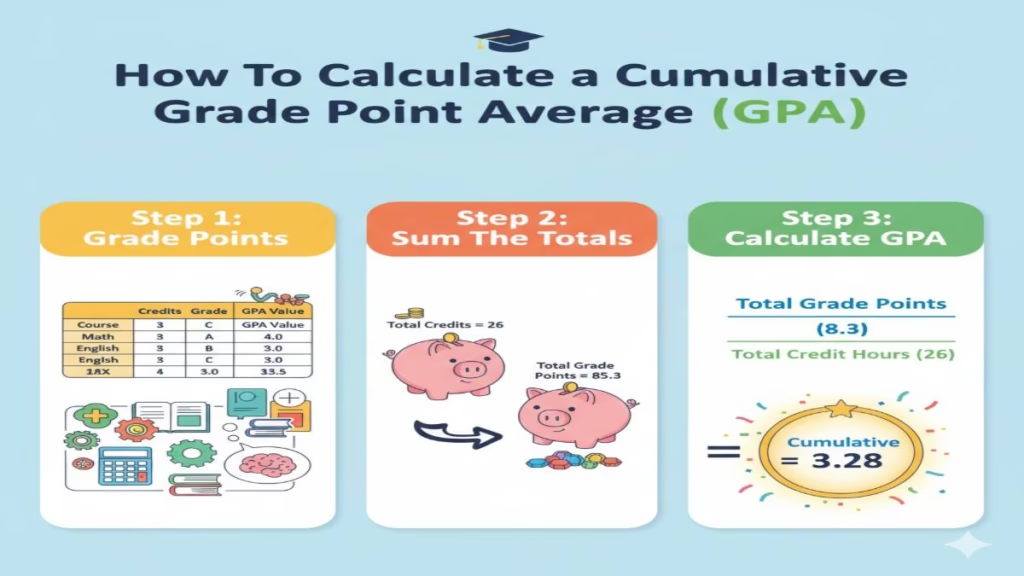
Understanding how to calculate your Cumulative Grade Point Average (GPA) is essential for tracking academic performance and setting future goals. Calculating your Cumulative Grade Point Average (GPA) is one of the most important steps in tracking your academic progress.
Whether you’re a high school, college, or university student, understanding how to calculate cumulative GPA helps you measure your overall performance across semesters.
This guide explains the GPA calculation formula, the difference between semester GPA and cumulative GPA, and how to use grade points and credit hours to find your exact score. By the end, you’ll be able to compute your total GPA accurately and understand how it impacts scholarships, admissions, and academic standing.
How To Calculate Cumulative Grade Point Average (GPA) Accurately
The Key Differences Between GPA and CGPA
While the terms are often used interchangeably, GPA (Grade Point Average) and CGPA (Cumulative Grade Point Average) represent distinct academic metrics. Understanding the difference is crucial for accurately assessing your academic performance.
The key distinction lies in their scope:
- GPA (Grade Point Average): This refers to your academic performance over a shorter, specific period, such as a single semester or academic term. It is a snapshot of your grades in that particular timeframe. For example, you might have a “3.8 GPA for the Fall 2023 semester.”
- CGPA (Cumulative Grade Point Average): This is the overall, running average of your grades across all semesters and courses completed in your academic career. It is the cumulative total of all your individual term GPAs. Your CGPA is the final number that typically appears on your transcript or degree certificate.
Analogy: A Book vs. The Entire Series
Think of your GPA as the rating for a single chapter in a book—it tells you how well that specific part was written. Your CGPA, however, is the average rating for the entire book series—it reflects the quality and consistency of the whole work.
Key Differences at a Glance
| Feature | GPA (Grade Point Average) | CGPA (Cumulative Grade Point Average) |
|---|---|---|
| Scope | Short-term (a single semester/term) | Long-term (entire academic program) |
| Represents | Performance in a specific set of courses | Overall academic performance across all courses |
| Timeframe | Changes every semester | Evolves continuously as new grades are added |
| Primary Use | Monitoring progress for a term | Graduation requirements, honors, job applications |
The Role of Your Cumulative GPA
Your cumulative GPA serves as a vital benchmark of your academic performance and long-term consistency for both higher education institutions and employers.
In the college admissions process, your high school cumulative GPA is a primary factor for admissions committees, helping them assess your potential for success at the university level.
Once enrolled, your college cumulative GPA becomes crucial for determining graduation requirements, eligibility for academic honors like summa cum laude, and your standing in class rank.
In the professional world, employers and recruitment teams analyze your cumulative GPA to evaluate candidates during the hiring process. It provides a data-driven snapshot of your work ethic and mastery of a subject, helping them decide if your profile aligns with their company’s standards.
While both college applications and job applications consider holistic factors like extracurricular activities, work experience, and letters of recommendation, your cumulative GPA offers a standardized metric for a direct comparison between applicants.
Unlike a single-semester term GPA, which is just a short-term academic snapshot, the cumulative GPA provides a comprehensive view of your entire academic track record.
For instance, a single semester of high grades followed by a semester of lower grades would present an incomplete picture if viewed in isolation.
The cumulative GPA neutralizes these fluctuations, giving admissions officers and hiring managers a more accurate and reliable measure of your overall capabilities and academic success.
GPA Formula Breakdown: Credit Hours, Grade Points & Weighted GPA Explained
Understanding how to calculate a cumulative GPA is essential for tracking your academic progress. While online GPA calculators are convenient, performing the cumulative GPA calculation manually provides deeper insight into how your overall GPA is determined. This step-by-step guide will walk you through the precise method to find your cumulative grade point average.
Step 1: Gather Your Transcript Data
Begin by collecting your academic transcript for all semesters. You will need the individual semester GPA and the corresponding total credit hours for each term. Ensure you have accurate figures, as lab courses or honors classes often carry different credit weights that are crucial for an accurate calculation.
Step 2: Calculate Total Grade Points for Each Semester
The core of the GPA formula involves converting your GPA into total points. Multiply each semester GPA by its total credit hours.
Example: A 3.5 GPA in a semester with 12 credit hours equals 42 total grade points (3.5 x 12 = 42). Repeat this process for every semester.
Step 3: Sum Your Total Credits and Points
Now, calculate two key totals:
- Add the credit hours from all semesters to find your cumulative credit hours.
- Add the total grade points from all semesters to find your cumulative total points.
Step 4: Compute Your Final Cumulative GPA
The final step in the cumulative GPA calculation is to divide your cumulative total points by your cumulative credit hours. The result is your official Cumulative Grade Point Average.
Crucial Note: You cannot simply average your semester GPAs, as this incorrect method fails to account for the varying credit hours each semester carries. This precise GPA formula ensures a weighted and accurate reflection of your entire academic record.
Here is a strong and clear example of a cumulative GPA calculation for a student who has completed two semesters:
🎓 Example of Cumulative GPA Calculation
To calculate the cumulative GPA, you need to first determine the total grade points earned and the total credit hours attempted across all semesters.
Step 1: Calculate Grade Points for Each Semester
| Semester | Course Name | Credit Hours (C) | Letter Grade | Grade Point Value (GPV) | Grade Points (C×GPV) |
| 1 | English 101 | 3 | A | 4.0 | 3 \times 4.0 = 12.0 |
| 1 | Biology 101 | 4 | B+ | 3.3 | 4 \times 3.3 = 13.2 |
| 1 | Math 101 | 3 | B | 3.0 | 3 \times 3.0 = 9.0 |
| 1 | History 101 | 3 | A- | 3.7 | 3 \times 3.7 = 11.1 |
| 2 | English 102 | 3 | B- | 2.7 | 3 \times 2.7 = 8.1 |
| 2 | Chemistry 101 | 4 | A | 4.0 | 4 \times 4.0 = 16.0 |
| 2 | Calculus 101 | 3 | C+ | 2.3 | 3 \times 2.3 = 6.9 |
| 2 | Psychology 101 | 3 | B | 3.0 | 3 \times 3.0 = 9.0 |
Step 2: Sum the Totals
Next, sum the total credit hours and the total grade points from all semesters:
| Total Category | Sum |
| Total Credit Hours (C) | 3 + 4 + 3 + 3 + 3 + 4 + 3 + 3 = 26 |
| Total Grade Points ($C \times GPV$) | 12.0 + 13.2 + 9.0 + 11.1 + 8.1 + 16.0 + 6.9 + 9.0 = 85.3 |
Step 3: Calculate the Cumulative GPA
The formula for the cumulative GPA is:

The student’s Cumulative Grade Point Average (GPA) is 3.28.
Conclusion
Mastering the process of how to calculate a cumulative GPA empowers you to take ownership of your academic trajectory. By accurately determining your Cumulative Grade Point Average, you gain a clear and honest benchmark of your performance, enabling you to set realistic goals, identify areas for improvement, and strategically strengthen your academic transcript.
Whether for scholarship applications, graduate school admissions, or personal achievement, your cumulative GPA is more than just a number—it’s a reflection of your consistent effort and dedication. Now that you possess this essential skill, regularly monitor your overall GPA to ensure you remain on track to meet your educational and career objectives.
Now that you understand the formula, put your knowledge into practice without the manual work! To quickly and accurately determine your academic standing, use our comprehensive suite of tools on our page featuring All GPA & CGPA Calculators in One Place. It’s the fastest way to compute your semester, cumulative, and even projected GPAs.