Students at any level—whether in high school, college, university students—need a way to track their academic progress over time. This is where the Cumulative Grade Point Average (CGPA) comes in.
It is essential to know why students need to calculate cumulative GPA for all semesters. This single number is often the first thing evaluated by future employers, scholarship committees, and graduate schools.
This guide provides a quick overview of what cumulative GPA means and the necessary tools for accurately calculating your academic standing.
What Is Cumulative GPA? (Beginner-simple Explanation)
The Cumulative GPA, or CGPA, is simply the weighted average of all the grades you have earned throughout your entire academic career at a single institution.
Think of it like an average score that keeps growing with every new semester.
Simple definition with an everyday example: If you drove 50 mph for one hour and 70 mph for two hours, your average speed isn’t 60 mph; it’s weighted more heavily by the time you spent driving 70 mph. CGPA works the same way, but with credit hours instead of time.
The difference between semester GPA and cumulative GPA is one of scope: Semester GPA reflects only the last few months of work, while CGPA summarizes everything you have done since day one.
When cumulative GPA is used (scholarships, job applications, academic standing): It is the standard metric used to determine eligibility for academic honors, to screen candidates for job interviews, and to ensure you maintain the required academic standing to continue your studies. It’s your permanent academic scorecard.
Cumulative GPA Calculator
Calculate your cumulative GPA across multiple semesters
How to Use This Calculator:
- Click “Add Semester” to add a new semester
- For each course, enter the course name, credit hours, and select your grade
- Click “Add Course” within a semester to add more courses
- Click “Calculate GPA” to see your cumulative GPA
- Use “Reset All” to clear all data and start over
GPA vs CGPA vs Semester GPA vs Cumulative GPA
Understanding the terminology is the first step toward calculating your final grade.
What is GPA (Grade Point Average)?
GPA is a broad term. In an academic setting, it represents the average numerical value of the letter grades you received. It can be applied to a single course, a semester, or cumulatively.
What is CGPA (Cumulative Grade Point Average)?
CGPA is the specific term used to refer to your overall, career-long GPA. It includes every class you have taken since enrollment.
What is Semester GPA?
The Semester GPA is the average of the grades you received only during that specific academic term. It is a snapshot of your performance during a single period.
Cumulative GPA vs Semester GPA — What’s the Difference?
The semester GPA resets to zero at the start of a new term, but the cumulative GPA does not. The CGPA is always carrying forward the data from all previous semesters. Knowing the cumulative GPA vs semester GPA — what’s the difference is crucial for tracking improvement.
CGPA Calculation All Semesters: Weighted vs Unweighted
The vast majority of college and university CGPA systems are weighted, meaning classes with more credit hours have a greater impact on your final score. This is why knowing CGPA calculation all semesters weighted vs unweighted is key; you must use the weighted method.
How to Calculate Cumulative GPA for All Semesters
The most accurate method to calculate cumulative GPA all semesters involves using all your data, not just the semester GPAs.
Understanding Credit Hours
Why credit hours change your GPA: Credit hours assign weight to a course. A difficult, time-intensive class (like a 4-credit course) should have more influence on your overall average than a quick, required seminar (like a 1-credit course).
Example: courses with 3 credit hours vs 1 credit hour: If you earn an ‘A’ (4.0) in a 1-credit course, you get 4 grade points. If you earn a ‘C’ (2.0) in a 3-credit course, you get 6 grade points. The poor grade in the higher credit course had a greater negative pull on your average.
Formula: Cumulative GPA Calculation Formula Semester Wise
To ensure you know the cumulative GPA calculation formula semester wise, remember the following simple fraction:
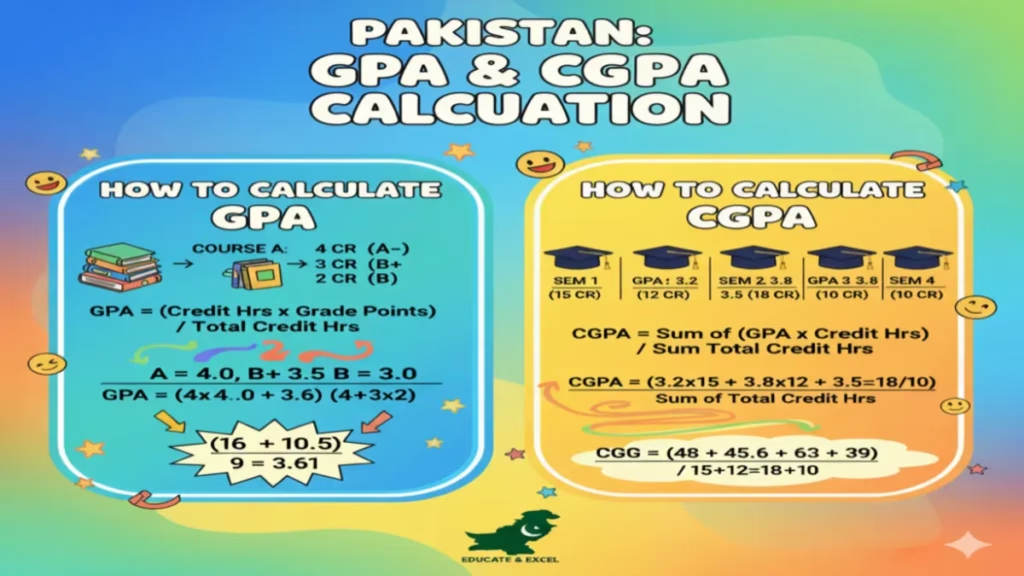
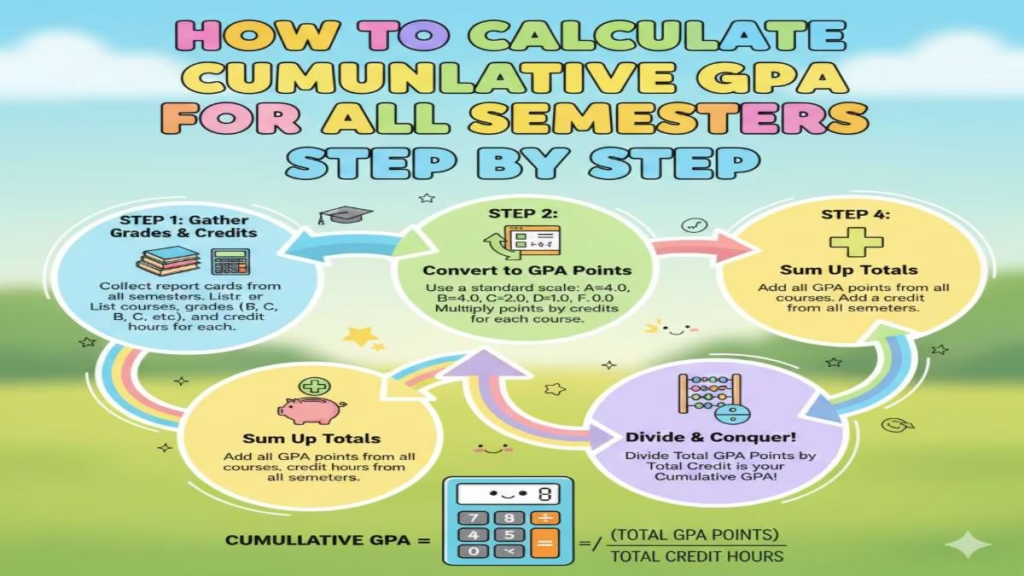
Cumulative GPA = (Total Grade Points of All Semesters) ÷ (Total Credit Hours of All Semesters)

Step-by-Step Cumulative GPA Calculator Manual Method
Here is the step by step cumulative GPA calculator manual method to find your exact score:
- Collect each semester’s GPA: Gather the official transcript data for all grades and corresponding credit hours for every course you have ever taken.
- Multiply each GPA by total credit hours: For every course (or use the totals from each semester): Grade Value × Credit Hours = Grade Points.
- Add all grade points: Sum the ‘Grade Points’ column from all your semesters together.
- Add all credit hours: Sum the ‘Credit Hours’ column from all your semesters together (this is your Total Credit Hours Attempted).
- Divide grade points by credit hours: Divide the Grand Total Grade Points (from step 3) by the Grand Total Credit Hours (from step 4).
- Final cumulative GPA: The result is your current CGPA.
How to Calculate Cumulative GPA Across Semesters (With Simple Examples)
This section shows how to find cumulative GPA across semesters by expanding the total number of credits and grade points.
Example: 2-Semester Calculation
- Semester 1: 40 Total Grade Points / 15 Total Credit Hours = 2.67 GPA
- Semester 2: 50 Total Grade Points / 15 Total Credit Hours = 3.33 GPA
- Cumulative: (40 + 50) Grade Points / (15 + 15) Credit Hours = 90 / 30 = 3.00 CGPA
Example: 4-Semester Calculation
Repeat the process: Sum Grade Points from Semesters 1, 2, 3, and 4. Divide by the total Credit Hours from all four semesters.
Example: How to Calculate Cumulative GPA in College for All Years/Semesters
This is the largest calculation. You simply keep adding the Grade Points and Credit Hours from every semester you complete until graduation. The method remains the same whether it’s two semesters or eight. How to calculate cumulative GPA in college for all years semesters only requires patience and accurate record-keeping.
How to Combine Semester GPA to Get Final GPA
Knowing how to combine semester GPA to get final GPA is simple if you follow the weighted rule.
Step-by-step explanation: The key is not to average the final semester GPA numbers (e.g., 3.0 + 3.5 = 3.25). Instead, you must combine the two underlying totals: total grade points and total credit hours.
Weighted example:
- Semester 1 (10 Credits, 3.5 GPA) = 35 Grade Points
- Semester 2 (15 Credits, 3.0 GPA) = 45 Grade Points
- Total CGPA = (35 + 45) / (10 + 15) = 80 / 25 = 3.20 CGPA
When combining GPAs gives wrong results: Averaging the semester GPAs (3.5 + 3.0) / 2 = 3.25 is wrong because it ignores the fact that Semester 2 had more weight (more credits).
How Do I Calculate Cumulative GPA With Different Credit Hours?
The question how do I calculate cumulative GPA with different credit hours is answered by the fundamental formula itself.
Weighted GPA calculation: The process relies entirely on the weighting provided by the credit hours. Every single course result is first multiplied by its respective credit hours before being included in the grand total sum.
Why this matters more than GPA alone: A simple GPA average can be misleading. The weighted calculation ensures your CGPA accurately reflects the volume and difficulty of the work completed.
Real-life beginner-friendly example: A 4-credit calculus course counts twice as much as a 2-credit fitness class, even if you got an ‘A’ in both.
GPA Calculation for All Semesters Including Repeats and Grade Changes
Understanding the GPA calculation for all semesters including repeats and grade changes depends heavily on your institution’s specific policy.
How repeated courses affect GPA: In most universities, if you repeat a course, only the last (or best) grade is used in the CGPA calculation, though the original attempt may remain on the transcript. Be sure to check your school’s official “Grade Forgiveness” policy.
How grade improvements update GPA: If a repeated course results in a higher grade, you must recalculate your total Grade Points and total Credit Hours by removing the points/hours from the lower, original grade and inserting the points/hours from the new, higher grade.
University policies (general explanation): Some schools average both grades, while others only use the final grade. Always consult your academic advisor or student handbook.
Calculate GPA for Multiple Semesters Using Excel
The best way to calculate GPA for multiple semesters excel formula is to use a simple spreadsheet. This minimizes manual calculation errors.
=SUMPRODUCT(GPA_range, CreditHour_range) / SUM(CreditHour_range)
Excel Formula Method
Sample formula for cumulative GPA: Use the SUM() function.
- Create a column for ‘Grade Points Earned’ (Column F).
- Create a column for ‘Credit Hours’ (Column D).
- The final cumulative GPA formula in a cell:
=SUM(F2:F20)/SUM(D2:D20)(Adjust range numbers as needed).
Provide a ready-to-copy formula: =SUM(Grade_Points_Column)/SUM(Credit_Hours_Column)
Excel GPA Table Example
You should set up a table that includes:
| Course | Grade | Credit Hours | Grade Value (e.g., 4.0 for A) | Grade Points (Credit Hours * Grade Value) |
| MATH 101 | B | 3 | 3.0 | 9.0 |
| ENG 101 | A | 3 | 4.0 | 12.0 |
Semester GPA to Overall GPA Conversion Guide
This semester GPA to overall GPA conversion guide focuses on predicting or tracking your overall score.
When to use this: Use this method when you want to know what GPA you need in your upcoming semester to reach a target cumulative GPA.
Common mistakes students make: The most frequent error is simply averaging your semester GPAs, which, as explained, ignores the crucial credit hours.
Quick formula + example: To find out what you need, use this:
Required Grade Points = (Target CGPA x Total Credit Hours) – Current Grade Points
Weighted vs Unweighted GPA: Which One Is Used in Cumulative GPA?
For new students, understanding this difference is vital.
Explanation for new students: Almost all universities use the Weighted method for the cumulative GPA, as credit hours are the standard measure of course load and impact.
Differences with examples: Unweighted GPA treats all courses (1-credit or 5-credit) as having equal importance. Weighted GPA assigns importance based on credit hours.
When universities use each method: Universities use weighted CGPA. The unweighted method is sometimes used informally or in high schools to provide a simple measure without complexity.
Step-by-Step Manual Method for Beginners
Let’s break the process down for someone completely new to the system.
- Assign Point Values: Convert your letter grades (A, B, C…) to their point equivalent (4.0, 3.0, 2.0, etc.).
- Multiply: For every single course, multiply its credit hours by its point value.
- Total Everything: Add up the results from the ‘Multiply’ step to get your Total Grade Points. Add up the credit hours to get your Total Credit Hours.
- Divide: Divide the Total Grade Points by the Total Credit Hours.
Use simple numbers: Example: 5 courses total. 15 total credit hours. 45 total grade points. CGPA = 45/15 = 3.00.
Add common student calculation errors to avoid: Do not include courses that were dropped or that were graded on a Pass/Fail basis unless your university explicitly states otherwise.
Tables, Charts
Having clear visual aids makes the process much simpler to follow, whether you’re performing the step by step cumulative GPA calculator manual method or using a spreadsheet. These tables provide the structure needed to accurately calculate your CGPA.
Sample Cumulative GPA Calculation Chart
This full table displays three semesters’ worth of data, illustrating how all course grades are combined to get a single cumulative total.
| Semester | Course | Grade | Credit Hours (A) | Grade Value (B) | Grade Points (A x B) |
| Semester 1 | Math 101 | B+ | 3 | 3.3 | 9.9 |
| History 101 | A | 3 | 4.0 | 12.0 | |
| Lab Science | C | 4 | 2.0 | 8.0 | |
| Subtotal S1 | 10 | 29.9 | |||
| Semester 2 | English 205 | A- | 3 | 3.7 | 11.1 |
| Psychology 101 | B | 3 | 3.0 | 9.0 | |
| Art Elective | A | 1 | 4.0 | 4.0 | |
| Subtotal S2 | 7 | 24.1 | |||
| Semester 3 | Physics 300 | B+ | 4 | 3.3 | 13.2 |
| Internship Prep | Pass | 1 | N/A | N/A | |
| Subtotal S3 | 4 | 13.2 | |||
| GRAND TOTAL | 21 | 67.2 | |||
| CUMULATIVE GPA | 67.2 / 21 | 3.20 |
Semester-by-Semester GPA Table
This simple table is perfect for tracking the final numbers each term and watching your cumulative score grow. This helps you track how to calculate CGPA semester by semester and overall CGPA.
| Semester | Total Credits (Attempted) | Total Grade Points | Semester GPA | Cumulative GPA |
| 1 | 15.0 | 45.0 | 3.00 | 3.00 |
| 2 | 15.0 | 55.5 | 3.70 | (45.0 + 55.5) / 30 = 3.35 |
| 3 | 12.0 | 36.0 | 3.00 | (100.5 + 36.0) / 42 = 3.25 |
| 4 | 16.0 | 60.8 | 3.80 | (136.5 + 60.8) / 58 = 3.40 |
Credit Hour Weight Table
This small table highlights why credit hour weight is so important. Notice how a single ‘B’ grade impacts your points total much more in a high-credit course.
| Credit Hours | Grade Earned | Grade Value (B=3.0) | Grade Points (Weight) |
| 1 | B | 3.0 | 1 x 3.0 = 3.0 |
| 3 | B | 3.0 | 3 x 3.0 = \9.0 |
| 5 | B | 3.0 | 5 x 3.0 = 15.0 |
People Also Ask some Questions
These common questions provide immediate, valuable answers.
- How do I calculate my GPA if I know my grades and credit hours?
- Answer: Multiply each grade’s point value by its credit hours. Sum those results and divide by the total number of credit hours.
- Can I calculate cumulative GPA without credit hours?
- Answer: No, an accurate cumulative GPA must be weighted by credit hours to reflect the effort and impact of each course.
- Does repeating a course raise cumulative GPA?
- Answer: Yes, typically, if you earn a higher grade the second time, as the old grade is often replaced, effectively removing lower grade points from the total.
- Is cumulative GPA the average of all semester GPAs?
- Answer: No, it is the weighted average, determined by dividing the total grade points by the total credit hours, not by simply averaging the semester GPA numbers.
- How do credit hours affect my final GPA?
- Answer: Credit hours serve as the ‘weight.’ A higher credit hour course has a much greater positive or negative impact on your final score than a lower credit hour course.
What Your Cumulative GPA Means
Once you have followed the semester GPA to overall GPA conversion guide and calculated your final number, what does it mean?
What is a good cumulative GPA? Generally, a 3.0 or higher is considered ‘good’ and demonstrates solid academic competency. A 3.5 or higher is often required for academic honors and many top graduate programs.
How institutions evaluate it: Institutions look not only at the final number but also at the trend. An improving CGPA over time is viewed very favorably.
GPA ranges explained (beginner-friendly chart suggestion):
| CGPA Range | Academic Standing |
| 3.5 – 4.0 | Excellent/Distinction |
| 3.0 – 3.49 | Good/Honors |
| 2.5 – 2.99 | Average/Satisfactory |
| Below 2.0 | Academic Probation/Warning |
Conclusion
You now have all the tools and knowledge necessary to accurately calculate cumulative GPA for all semesters.
Remember the importance of accuracy in GPA calculation: your entire academic history relies on it. To avoid mistakes, utilize the step by step cumulative GPA calculator manual method alongside the Excel spreadsheet method. A quick reminder to double-check credit hours—they are the most crucial part of the weighted average. Good luck tracking your success!
Frequently Asked Questions (FAQ)
Explore More Helpful Calculators and Guides
Understanding your academic performance doesn’t stop at one calculation. Whether you’re planning your future grades, converting between different grading systems, or just trying to understand what your scores really mean, we have a full suite of tools and guides to help you succeed.
And for the ambitious students aiming for the top, have you ever wondered what is the highest GPA you can actually achieve? We break down the maximum possible scores in different educational systems.
If you’re focused on your long-term academic record, our comprehensive CGPA Calculator is your go-to tool for tracking performance across all your semesters.
Planning for future success is key. Use our GPA Planning Calculator to set realistic goals and figure out exactly what grades you need to hit your target GPA.
For a quick and simple calculation without the complexity of multiple semesters, our general Online Calculator for GPA provides a fast and accurate result.
Are you applying to international programs? You might need to convert your CGPA to a standard 4.0-scale GPA, and our dedicated converter makes it easy.
For students coming from a percentage-based system, our specialized Percentage to CGPA Calculator takes the guesswork out of the conversion.
Remember, grades aren’t everything. Keep track of your class commitment with our simple Attendance Percentage Calculator.
Wondering how your score measures up? Our insightful article on what is considered a good GPA in university gives you the context and benchmarks you need.
Navigating different international systems can be tricky. If you’re dealing with Swiss grades, our guide on the Swiss grading system and its conversion to GPA is an essential read.