
If you are a student, you have undoubtedly heard the term grade point average or GPA. This single number is one of the most critical factors in your academic life. It is the core measure of your success, reflecting your overall performance across all your courses. For students in high school, college, and university, your GPA matters greatly for college applications, scholarships, and even future job prospects. If you’ve ever wondered how do I calculate my grade point average, this simple guide will walk you through each step.
What is Grade Point Average (GPA)?
A grade point average is a number representing the average value of the accumulated final grades you earn in each class. It reflects your overall academic performance by converting letter grades into numerical points.
Understanding the GPA grading scale is key. Most institutions use a standard scale where an ‘A’ equals 4.0 points, a ‘B’ equals 3.0, and so on. The specific number of GPA points per grade will vary slightly depending on whether the scale is weighted or unweighted.
How is GPA Calculated?
The GPA formula is straightforward and uses just two main components: the total number of grade points you have earned and the total number of credit hours you have attempted.
Here is the formula to calculate GPA manually:
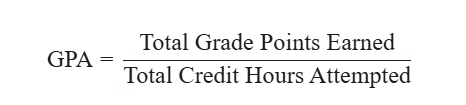
To perform a simple GPA calculation, you first need to convert your letter grades into numerical grade points and then multiply each by its respective course credit hours. After totaling these up, divide by the total number of credit hours. This step by step GPA calculation is the backbone of finding your GPA.
Types of GPA Calculations
Not all GPAs are created equal. Depending on your courses and institution, your GPA might be calculated differently. Learning how to find GPA for these different types is essential for accuracy.
A. Unweighted GPA
An unweighted GPA is the most common form, typically calculated on a 4.0 scale. It does not factor in the difficulty of your courses. Whether you earned an ‘A’ in a standard class or an advanced class, both are valued at 4.0 grade points. You would use an unweighted GPA calculator for this type of assessment.
B. Weighted GPA
A weighted GPA accounts for the rigor of advanced courses like AP, IB, or Honors classes. In this system, an ‘A’ in a challenging course might be worth 5.0 points instead of 4.0. If your school uses this method, you will need a weighted GPA calculator or a GPA calculator with credits to account for these extra points.
C. Cumulative GPA
Your cumulative GPA calculator tracks your total GPA throughout your entire academic career—for example, your four years of high school or all semesters of college. This is different from a semester GPA calculator, which only calculates the average for a specific term.
GPA Calculation Examples
Let’s look at a concrete example to calculate GPA manually and see how to calculate GPA score.
| Course | Letter Grade | Grade Points | Credit Hours | Grade Points × Credit Hours |
| Math | A | 4.0 | 3 | 4.0 x 3 = 12.0 |
| History | B | 3.0 | 3 | 3.0 x 3 = 9.0 |
| Biology | C | 2.0 | 4 | 2.0 x 4 = 8.0 |
| Totals | 10 | 29.0 |
To calculate grade average, you follow the formula:

The student’s GPA is 2.9. This shows you exactly how to calculate grade points and then the final average.
How to Calculate GPA Using Online Tools
While it is good to know the formula, the fastest way to get your results is to calculate my GPA online. An online GPA calculator can instantly deliver an accurate result.
You can find specialized tools like a college GPA calculator, a high school GPA calculator, or even one that uses the specific university GPA formula. A quick GPA calculator or grade point calculator online is simple to use: you input your grades and credit hours, and the tool does the math for you. These tools are often available as a GPA calculator for students on educational websites.
Converting Grades and Percentages to GPA
If your school gives you a percentage grade (like 85%) instead of a letter grade (like B), you will first need to convert grades to GPA.
The standard percentage to GPA conversion usually follows a predetermined GPA conversion chart. For example:
- 90–100% = A = 4.0
- 80–89% = B = 3.0
- 70–79% = C = 2.0
Always check your institution’s official chart, as these conversion points can vary.
| Letter Grade | Percentage Range | Standard Unweighted GPA Points (4.0 Scale) |
| A+ | 97 – 100 | 4.0 |
| A | 93 – 96 | 4.0 |
| A- | 90 – 92 | 3.7 |
| B+ | 87 – 89 | 3.3 |
| B | 83 – 86 | 3.0 |
| B- | 80 – 82 | 2.7 |
| C+ | 77 – 79 | 2.3 |
| C | 73 – 76 | 2.0 |
| C- | 70 – 72 | 1.7 |
| D+ | 67- 69 | 1.3 |
| D | 65 – 66 | 1.0 |
| F | Below 65 | 0.0 |
Common Mistakes in GPA Calculation
Even with a simple formula, students often make errors. A common mistake is miscounting the credit hours for non-academic courses like physical education, which may not count toward your academic GPA. Another error occurs with the rounding of the final number.
To ensure you know how GPA is calculated accurately, always double-check the credit hours and the numerical point value assigned to each letter grade. Learning how to compute GPA correctly means paying attention to these small details. If your school uses a marks-based system, be careful when you calculate GPA from marks to use the right conversion table.
Why Knowing Your GPA Matters
Your Grade Point Average (GPA) is far more than just a number on a transcript; it is a critical metric that summarizes your academic performance. Understanding its importance, and knowing how to calculate GPA accurately, is essential for navigating your educational and professional journey.
1. College and University Admissions
This is one of the most significant reasons your GPA is crucial. Admissions committees use your high school GPA as a standardized measure to assess your academic readiness and consistency. Whether you’re aiming for a competitive program or a standard admission, knowing your unweighted GPA (which typically uses a standard 4.0 scale) and your weighted GPA (which accounts for the difficulty of honors, AP, or IB classes) is vital. Using a high school GPA calculator can help you determine where you stand and what schools might be a good fit.
2. Scholarships and Financial Aid
Many scholarships, especially merit-based ones, have strict GPA requirements. A higher GPA can open doors to substantial financial awards, reducing the burden of tuition. By using a college GPA calculator or a semester GPA calculator to track your performance, you can ensure you meet the necessary thresholds to qualify for and maintain this crucial funding.
3. Academic Standing and Program Eligibility
Within a university, your GPA determines your academic standing. Falling below a certain average can result in academic probation. Furthermore, specific majors, honors programs, and pre-professional tracks (like pre-med or pre-law) often require a minimum GPA for entry and continuation. Understanding the university GPA formula and performing a simple GPA calculation at the end of each semester allows you to monitor your progress and make informed decisions about your course load.
4. Internships and Graduate School
When applying for competitive internships or graduate programs (like law or medical school), your GPA is often one of the first filters used by recruiters and admissions boards. It serves as a quick indicator of your work ethic and mastery of the subject matter. For graduate school applicants, knowing how to find GPA and potentially convert it (using a GPA conversion chart) is essential, especially when dealing with different grading systems.
5. Personal Benchmarking and Goal Setting
On a personal level, your GPA is a tool for self-assessment. Regularly using a CGPA calculator online (Cumulative Grade Point Average) helps you track your long-term progress. It allows you to identify areas for improvement, set realistic academic goals, and stay motivated throughout your educational career.
How to Stay on Top of Your GPA
Fortunately, you don’t need to master complex math to stay informed. The process of how to calculate GPA is straightforward once you understand the GPA formula:
- Identify the Grading Scale: Consult your institution’s GPA grading scale to see the point value for each letter grade (e.g., A=4.0, B=3.0).
- Calculate Grade Points: For each course, multiply the grade point value by the number of credit hours for that course.
- Find the Total: Add all the grade points you earned across all courses.
- Divide by Total Credits: Divide the total grade points by the total number of credit hours attempted.
This is the core of a simple GPA calculation. To make this process effortless, you can use various online tools like a weighted GPA calculator (if your school gives extra points for difficult classes) or an unweighted GPA calculator. A semester GPA calculator is perfect for tracking short-term progress.
How to improve your GPA?
Use a GPA Calculator to Plan and Track
Before and after each semester, use a college or high school GPA calculator. Input your current grades and potential future grades to see exactly how they will impact your cumulative GPA. This helps you set realistic targets and understand which classes need the most focus.
Master the GPA Formula for Strategic Focus
Understand the basic GPA calculation: each class’s grade points (from the GPA grading scale) are multiplied by its credit hours. The sum is then divided by your total credits. Knowing this formula helps you prioritize; a high-credit course has a greater impact on your grade point average than a low-credit one.
Aim for Higher Grades in High-Impact Courses
The simplest way to improve your cumulative GPA is to earn better grades in classes with more credit hours. Use a semester GPA calculator to see how raising your grade in a multi-credit course significantly boosts your average compared to a one-credit class.
Know Your System: Weighted vs. Unweighted
Use the correct calculator—a weighted GPA calculator for high school programs that award extra points for honors/AP/IB classes, or an unweighted GPA calculator if all courses are on a standard 4.0 scale. This ensures your calculations are accurate and your improvement goals are aligned with your school’s system.
Perform a Simple GPA Calculation After Each Assignment
Don’t wait for finals. Regularly calculate your grade average in each class after every major test or assignment. This ongoing awareness allows you to identify problems early and seek help immediately, preventing a last-minute crisis.
Conclusion
You have now mastered the steps required to calculate your academic average. The process involves knowing your course grades, understanding the corresponding numerical points, and applying a straightforward division formula.
If you know how to calculate my GPA step by step, you possess an essential tool for tracking your academic progress. Now that you know how to calculate your grade point average, you can easily track your academic progress and set goals for improvement.
FAQs About GPA Calculation
Use Our Interactive GPA Calculator Tool
Need an instant result? Forget the manual math! Use our quick GPA calculator to find your exact GPA instantly!