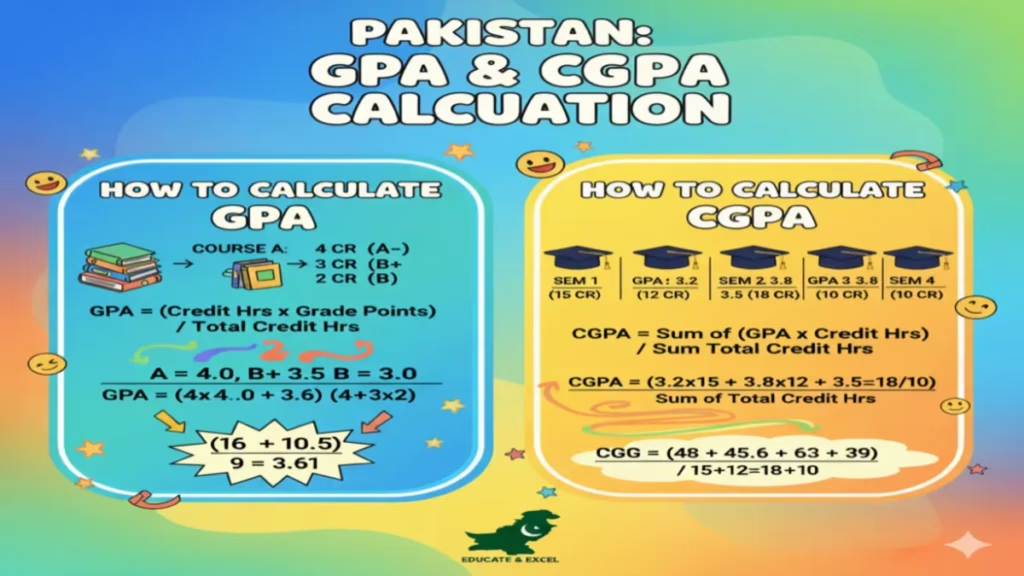
Figuring out your percentage from your CGPA for engineering can be confusing. You might be applying for jobs, higher studies, or just want to know where you stand. The process isn’t the same for every university. This guide will clear all your doubts. We will explain the common formulas, university-specific rules, and how to get it right.
Understanding this conversion is crucial for your career. It helps you fill out application forms correctly. Moreover, it ensures you present your academic record in the best possible way. Let’s break down everything you need to know.
Convert Your CGPA to Percentage in Engineering Accurately
Before we convert, let’s understand what CGPA means. CGPA stands for Cumulative Grade Point Average. It is the average of your grade points across all semesters.
Think of it as a summary of your overall performance. Instead of percentages for every subject, you get a single number. This number is usually on a 10-point scale.
- Grade Points: Each letter grade (like A, B, C) has a number value.
- Credit Hours: Each subject has a credit value based on its importance.
- Calculation: Your CGPA is the total grade points earned divided by the total credit hours.
The engineering grading system uses CGPA to standardize performance. It provides a uniform way to assess students from different universities. However, this creates a need for conversion when a percentage is required.
Why Converting CGPA to Percentage is Essential for Engineers
You might wonder why we can’t just use the CGPA. The reason is that many institutions and companies still operate on a percentage system. Knowing your equivalent percentage opens many doors.
For instance, when applying for a Master’s degree abroad, universities often ask for a percentage. Many job application forms, especially in the private sector, have a field for percentage. Some competitive exams also have percentage-based eligibility criteria.
Therefore, a correct CGPA to percentage conversion is vital. It accurately represents your hard work. A wrong calculation could potentially undersell your achievements. This guide will ensure that doesn’t happen.
The Most Common CGPA to Percentage Formula
The most widely accepted method is simple. You multiply your CGPA by a factor. For most Indian engineering universities, this factor is 9.5.
The Formula:
Percentage = CGPA × 9.5
This multiplier was derived from the historical average performance of students. It bridges the gap between the grade point and percentage systems.
Engineering CGPA Conversion Formula & % Calculation Method
Let’s make this process easy with simple steps.
- Find Your Final CGPA: Check your official transcript for your final CGPA score.
- Apply the Multiplier: Take that CGPA and multiply it by 9.5.
- Get Your Percentage: The result is your equivalent percentage.
Example:
If your CGPA is 8.5, your calculation would be:
8.5 × 9.5 = 80.75%
So, an 8.5 CGPA translates to 80.75%.
This method is a safe bet if your university hasn’t specified a different formula.
University-Specific Conversion Formulas
Not all universities follow the 9.5 rule. Some have their own official formulas. It is crucial to know your university’s policy.
The VTU Formula
Visvesvaraya Technological University (VTU) uses a different calculation.
Their formula is: Percentage = (CGPA – 0.75) × 10
Example:
If your VTU CGPA is 9.00, your percentage is:
(9.00 – 0.75) × 10 = 82.5%
Other University Variations
- Some institutions may use a multiplier of 10 directly.
- Others might have a more complex calculation based on credit weights.
- A few universities even provide a conversion certificate.
Always check your university’s academic office or website first. Using the wrong formula can lead to discrepancies. This is especially important for official documents.
Converting CGPA to Percentage on a 4-Point Scale
Some international contexts use a 4-point GPA scale. The conversion from a percentage to this scale is different.
A common and straightforward formula is:
GPA on a 4.0 scale = Percentage / 25
This provides a quick equivalence.
Example:
If you have a percentage of 90%, your GPA would be:
90 / 25 = 3.6 on a 4.0 scale.
It’s important to note that this is a general guideline. Different foreign universities have their own more detailed conversion tables. Always check the specific requirements of the institution you are applying to.
A Practical CGPA to Percentage Conversion Table
A conversion table offers a quick reference. You don’t have to calculate every time. Here is a table based on the common 9.5 multiplier.
| CGPA | Equivalent Percentage |
|---|---|
| 10.0 | 95.0% |
| 9.5 | 90.25% |
| 9.0 | 85.5% |
| 8.5 | 80.75% |
| 8.0 | 76.0% |
| 7.5 | 71.25% |
| 7.0 | 66.5% |
| 6.5 | 61.75% |
This CGPA to percentage chart for engineering helps you estimate your score instantly.
How to Choose the Right Conversion Formula
With multiple formulas, how do you pick the correct one? Follow this simple rule-set.
- First Priority: Always use the formula provided by your university. This is the only method that is officially valid for you.
- Second Priority: If your university has no specific rule, use the standard 9.5 multiplier. It is the most recognized method across India.
- For International Applications: When applying to foreign universities, use their recommended conversion method. Many have their own online calculators or specific tables.
When in doubt, seek clarification. Contact your college’s examination cell or academic advisor. Providing an inaccurate percentage can have serious consequences.
Conclusion: Presenting Your Score with Confidence
Converting your CGPA to percentage for engineering is a straightforward process once you know the rules. Remember to always prioritize your university’s official formula. The standard 9.5 multiplier is your best friend if no specific rule exists.
Use this guide as your reliable resource. Whether you are filling out a job form or a university application, you can now do it with confidence. Your hard work deserves to be represented accurately. Good luck