
Every university student has experienced the knot in their stomach when they check their grades. The universal student anxiety about GPA centers on that one number, a tiny decimal that seems to carry the entire weight of your future. You’ve asked, “What is a Good GPA in University?”
The simple answer is that the question is inherently flawed. A “good” GPA is entirely contextual. It’s not a fixed number; it’s a number that aligns with your specific post-graduation goals. A 3.0 might be fantastic for one student’s career path and insufficient for another’s.
The purpose of this guide is to move beyond a simple number and provide a framework for you to evaluate your own GPA. We’ll show you how to judge your academic standing based on your unique major, career track, and personal aspirations.

The Baseline: Understanding GPA Benchmarks
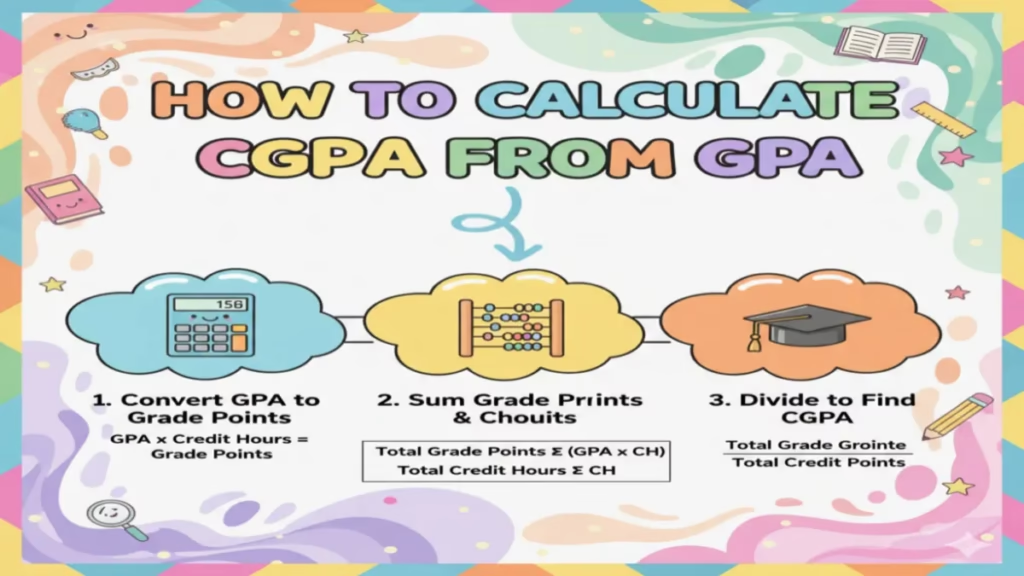
A Grade Point Average (GPA) is calculated on a 4.0 scale, where a 4.0 represents a perfect score (all A’s). While the calculation itself is straightforward—total grade points divided by total credit hours—the interpretation is anything but.
General GPA Classifications
Academic performance often falls into distinct brackets that signal different levels of achievement to institutions and employers:
- The “Safe Zone” (3.5-4.0): Generally considered excellent, often qualifying you for Dean’s List and making you highly competitive for top graduate programs and selective scholarships.
- The “Competitive Zone” (3.0-3.49): A very solid performance. This range meets the minimum requirements for most jobs and places you within the average for many graduate school applications.
- The “Improvement/Mitigation Zone” (2.5-2.9): Requires strategic planning. While you may face some initial hurdles, this is often manageable with a strong resume and experience.
- The “Academic Probation” Zone (Below 2.0): Indicates significant difficulty and often requires immediate intervention from the university’s academic advising office.
Is a 3.5 GPA in University the Same as in High School?
No, they are often worlds apart. University-level work involves much greater rigor, depth, and personal responsibility. High schools may also employ grade inflation more readily. Therefore, achieving a 3.5 GPA in university, particularly in a demanding program, usually signifies a higher level of mastery and commitment than the same number achieved in high school.
Context is Everything: What is a “Good” GPA for Your Goals?
The most critical factor in defining a “good” GPA is your context. Your major, career path, and the institutions you target all define the goalpost.
By Academic Major
Different disciplines come with different historical grade curves and difficulty perceptions. For instance, you should consider what constitutes a good GPA for engineering majors vs liberal arts.
- For technical fields, the average GPA for computer science students at top universities may be slightly lower than in humanities due to the demanding nature of the coursework. The sheer volume and complexity of material mean that a 3.3 or 3.4 is often highly respected.
- Conversely, is a 3.7 GPA good for a business major? Absolutely. Due to the high number of applicants and the perception of a less steep learning curve, business and finance programs often require a higher GPA to stand out in the competitive applicant pool.
- Ultimately, the question you should ask yourself is: what is a respectable GPA in a rigorous program? It’s one that shows consistent effort and mastery, even if it’s slightly lower than the university’s overall average.
For Graduate & Professional School
If your goal is advanced study, your GPA becomes arguably the single most important metric for initial screening.
- Achieving a competitive GPA for medical school applications is demanding, typically requiring a 3.7 or higher to be seriously considered, alongside a stellar MCAT score and clinical experience.
- Students aiming for elite institutions often ask, what GPA do I need for an Ivy League graduate program? The answer usually hovers around 3.8 to 4.0, though strong essays and recommendations can sometimes compensate.
- The GPA expectations for pre-law students are also high, often requiring a 3.5 or better, combined with a strong LSAT score, to open doors to top-tier law schools.
- If your GPA is lower, you might worry, can I get into a good grad school with a 3.3 GPA? Yes, it is possible. You will need exceptional test scores, compelling work experience, and a narrative that explains your academic trajectory.
By University Tier & Type
The prestige of the degree-granting institution also plays a part in perception.
- Students often wonder, does a good GPA at a community college transfer the same weight? For state universities, an excellent community college GPA is highly valued and often provides a direct pathway. For highly selective universities, it is still a strong component, but they will also look closely at your performance once you enroll in their upper-level courses.
GPA and Your Career: How Much Does It Really Matter?
The role of your GPA changes drastically depending on your career stage.
The First Job and Internships
At the start of your career, GPA is a proxy for performance because you lack professional history.
- How important is GPA for your first job out of college? It can be extremely important. Many large companies, especially in finance, consulting, and engineering, use GPA as a quick filter for entry-level positions.
- When seeking an initial role, you’ll look at GPA for internships: what do companies look for? Most Fortune 500 companies have a hard cutoff of 3.0 or 3.2 for internship applications.
- You might ask, do employers care about GPA for tech jobs? While the tech industry is generally more focused on portfolios and projects, many major tech firms still screen for a minimum GPA for new university graduates.
The Long-Term View
As you gain experience, your GPA rapidly loses relevance.
- Does GPA matter after you have work experience? Generally, no. Once you have two or three years of professional experience, your work performance and professional references become the primary indicators of your ability.
- The reality is that how much does GPA actually matter for long-term career success is very little. Your long-term success hinges on soft skills, networking, and continuous learning.
- Ultimately, what does your GPA really tell employers about you? It demonstrates your consistency, work ethic, and ability to meet deadlines and perform structured tasks in a university environment—skills that are foundational but quickly superseded by real-world job performance.
Action Plan: What to Do With Your Specific GPA
No matter your GPA, you have a strategy for maximizing its impact.
The Resume Test: To List or Not to List?
Knowing when to include this number is a key decision.
- If your GPA is strong, you might ask, should I list a 3.4 GPA on my resume? If it is above a 3.0, yes, listing it is generally beneficial for your first job or internship.
- A clear rule of thumb dictates when to take your GPA off your resume: after two to three years of full-time professional experience, or immediately if your GPA is below the 3.0 cutoff.
Strategies for a “Low” or Mediocre GPA
If your GPA is lower than you’d like, focus on mitigation.
- If you’re asking what to do if my GPA is below 3.0 for job applications, the answer is to leave it off the resume and focus heavily on experience and skills.
- A powerful strategy is to learn how to offset a mediocre GPA with other achievements. This includes major personal projects, leadership roles, impactful volunteer work, or a strong portfolio.
- It’s vital to practice strategies to explain a low GPA in a job interview. Prepare a brief, honest, and positive narrative that frames your past academic struggles as a period of growth and maturity, perhaps emphasizing a strong improvement trend in your later years.
Maximizing a High GPA
A high GPA opens doors, but it isn’t the final answer.
- A high GPA is crucial for the role of GPA in securing competitive scholarships and funding for both undergraduate and graduate study.
- For those chasing perfection, consider: is a 4.0 GPA always a good thing? While impressive, a 4.0 that came at the cost of all extracurriculars and personal well-being is often less beneficial in the long run than a slightly lower GPA earned with a healthy balance.
Beyond the Number: A Nuanced Look at Academic Success
To truly thrive, you need to see the bigger picture.
Cumulative GPA vs Major GPA: Which Matters More?
For many graduate programs and some employers, your cumulative GPA vs major GPA which matters more is an easy choice—they care about the major one. It reflects your performance in the subjects most relevant to them.
If your major GPA is significantly higher, you should list it alongside or instead of your cumulative GPA. Wondering how to calculate my major-specific GPA? It’s simple: add up the grade points for all the courses required for your major, then divide by the total number of major course credits.
GPA vs Relevant Experience: Which is More Important?
In today’s job market, for most roles, experience wins. The debate of GPA vs relevant experience which is more important is often settled in favor of experience. An internship where you accomplished something tangible is almost always more valuable than a 0.1 point increase in your GPA.
What is More Important Than GPA in University?
So much! Ask any successful graduate what is more important than GPA in university, and they’ll list things like:
- Building a professional network.
- Securing impactful internships.
- Developing real-world skills.
- Learning to work in teams.
- Maintaining your mental and physical health.
This leads to a vital reflection: is a 3.8 GPA worth the stress and social sacrifice? Only you can answer that. But remember, balance is key to long-term success and happiness.
Understanding GPA Inflation and How It Affects Job Markets
It’s also useful to be aware of the broader trend of understanding GPA inflation and how it affects job markets. As average GPAs creep up over time, it can make a “good” GPA from today less standout than the same GPA from decades ago. This is another reason why employers are looking beyond the number to other qualifications.
Conclusion: Your GPA is a Data Point, Not Your Destiny
We’ve covered a lot of ground. The key takeaway is that a “good” GPA is personally and contextually defined. It’s a tool, not a trophy.
It’s an important number, yes. But it is just one part of your much larger and more interesting story.
So, take a deep breath. Focus on learning, building real skills, and gaining experiences that genuinely excite you. Network, get involved, and don’t forget to live your life.
Let your GPA be a natural result of your hard work and curiosity, not the sole purpose of your university journey. Your future is built on much more than that.
Understanding your GPA often requires knowing exactly how it’s calculated and how it translates across different systems. If you’re ready to move past the general guidelines and into the specifics of your own academic performance, we have specialized guides to help you master the mechanics of your grades.
- Need to understand your numerical standing? If you have a $3.0$ GPA and are curious what that looks like in a different format, you can easily look up how to convert a specific 3 GPA to percentage. This is often crucial for international applications or job forms that request a percentage equivalent.
- Comparing international credentials? For readers who are studying abroad or applying to international programs, understanding global equivalencies is essential. Learn about the specifics of the Swiss Grading System to GPA and how those unique scores translate into the $4.0$ scale used in North America.
- Aiming for the top? If you are striving for academic excellence and want to fully grasp the potential of the grading system, find out what is the highest GPA you can get and the difference between a simple $4.0$ and a weighted GPA.
- Want to check the math yourself? Every student should know the precise method used to measure their performance. We provide a clear guide on how do I calculate my grade point average to ensure your number is accurate every time.
- Understanding different metrics? Many academic systems use both CGPA (Cumulative GPA) and percentages. Get a clear breakdown of which is better, CGPA or percentage, and understand why some institutions favor one metric over the other.