Navigating the world of academic credentials can feel like decoding a secret language, especially when you’re faced with different grading scales. If you have a Cumulative Grade Point Average (CGPA) on a 4.0 scale and need to convert it to a percentage for a job application, higher studies, or a scholarship, you’ve come to the right place. This comprehensive guide will walk you through the most accurate methods, debunk common myths, and provide the clarity you need.
Free Online GPA Calculator
Standard Semester Calculator (4.0 Scale)
GPA to CGPA Calculator
CGPA to GPA Calculator
Percentage to CGPA Calculator
GPA Planning Calculator
GPA to Percentage Calculator
CGPA To Percentage Calculator Out Of 4
CGPA Calculator
Calculate cumulative GPA by combining previous semesters.
GPA Calculator for University
For universities with non-standard grading scales. Enter exact points manually.
Calculate Attendance Percentage
UOG GPA Calculator
University of Gujrat Scale
COMSATS GPA Calculator
CIIT Decimal Scale
Convert CGPA Into Percentage Out Of 4 (With Calculator)
What is CGPA on a 4.0 Scale?
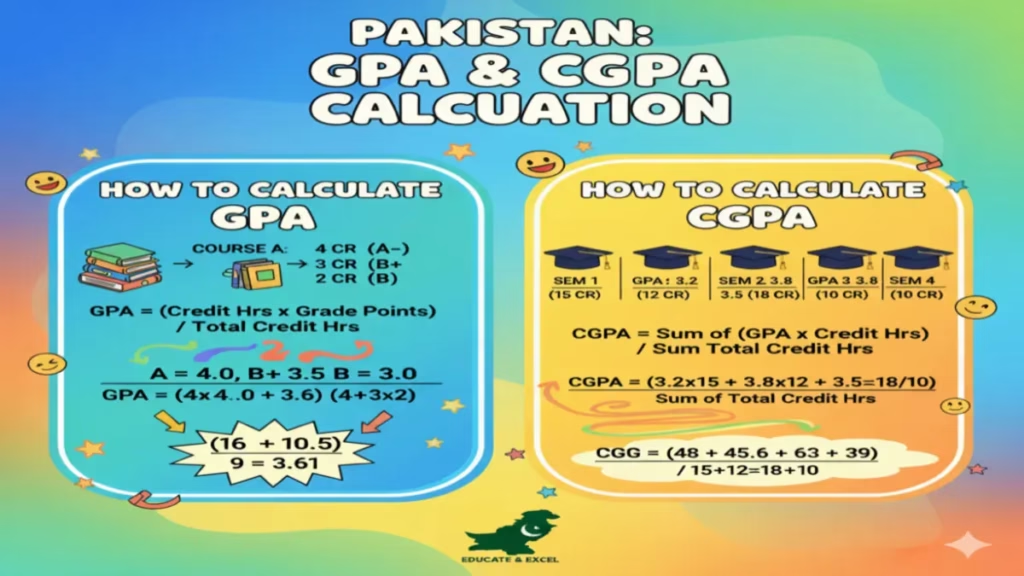
Before we dive into conversion, let’s establish what we’re working with. The 4.0 CGPA scale is a standardized grading system used by countless universities worldwide, particularly in the US, Canada, and many other countries. It provides a holistic view of your academic performance by averaging your grade points across all semesters or courses.
- A = 4.0 (Excellent)
- B = 3.0 (Good)
- C = 2.0 (Average)
- D = 1.0 (Pass)
- F = 0.0 (Fail)
Your CGPA is the cumulative average of these points, offering a clean, single-digit representation of your academic standing.
There is No One-Size-Fits-All Formula
This is the most critical piece of information. A universal, legally binding formula to convert a 4.0 GPA to a percentage does not exist. The conversion method depends entirely on your specific university’s or educational board’s grading policy.
The reason is simple: a “B” grade at one university might represent a score range of 80-84%, while at another, it could be 83-86%. This variation makes a single formula inaccurate.
However, we can explore the most common and accepted methods.
Method 1: The Standard 10-Point Multiplier (The Most Common Shortcut)
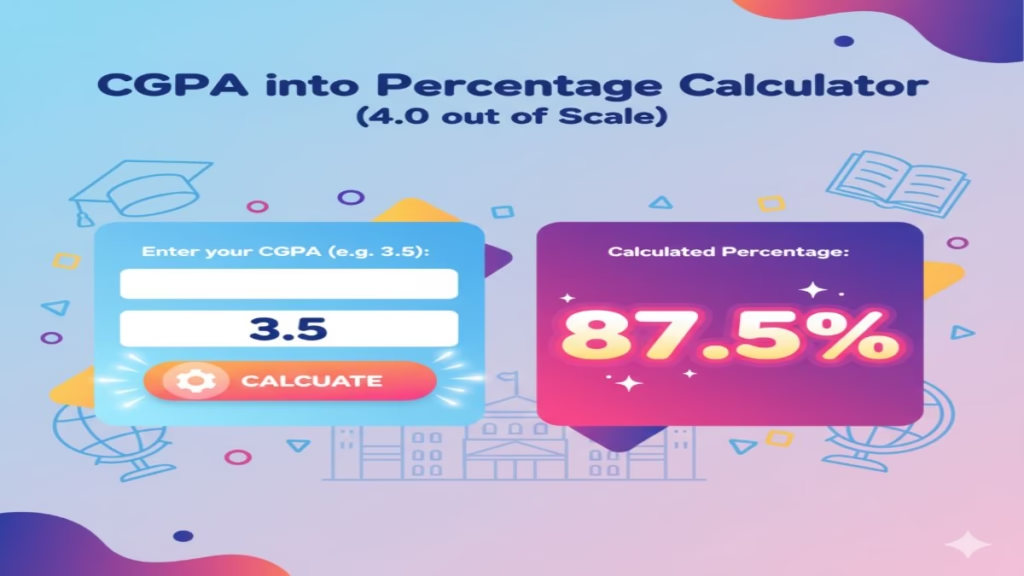
The most widely used and simplest method is to multiply your CGPA by 25. This effectively scales your 4.0-point score to a 100-point percentage system.
Formula:
Percentage = CGPA (on a 4.0 scale) × 25
Example Calculation:
If your CGPA is 3.6, your calculated percentage would be:
3.6 × 25 = 90%
This method is a great general-purpose tool and is accepted by many institutions for preliminary assessments. It’s the go-to for a quick CGPA to percentage conversion.
Method 2: The Institution-Specific Formula (The Most Accurate)
For official purposes, such as sending transcripts for graduate school applications, this is the only method you should use. Many universities define their own conversion scale in their academic handbook or on the back of their official transcripts.
How to find it:
- Check your university’s official website, specifically the “Academics” or “Registrar” section.
- Look at your official transcript; a conversion chart is often printed on the reverse side.
- Contact your university’s examination cell or registrar’s office directly.
Example of a University-Specific Scale:
- A (4.0) = 93% – 100%
- A- (3.7) = 90% – 92%
- B+ (3.3) = 87% – 89%
- B (3.0) = 83% – 86%
- …and so on.
In this case, a CGPA of 3.7 would not simply be 3.7*25=92.5%. It would officially correspond to a percentage range of 90-92%.
Factors for an Accurate Conversion
1. WES and Other Credential Evaluation Services
If you are applying to universities or for jobs abroad, especially in the US or Canada, you may need to use a service like World Education Services (WES). These bodies have their own sophisticated conversion tools that consider the country of origin, the university’s reputation, and the specific grading system. They provide an official evaluation that institutions trust.
2. Understanding the “4.0 Scale” Variations
Be aware that not all 4.0 scales are identical. Some institutions use a “4.0 Scale with A+” which might be worth 4.3, allowing for a GPA slightly above 4.0. Others might use a more granular scale with “+” and “-” grades. Always clarify which specific 4.0 scale your university employs.
Actionable Steps and Best Practices
To ensure your CGPA percentage calculation is correct and credible, follow this checklist:
- Prioritize Official Channels: Your first step should always be to check your university’s official policy.
- Use the 25x Multiplier for Estimates: For quick calculations on application forms or personal assessments, the CGPA x 25 formula is perfectly acceptable.
- Be Transparent: When listing your percentage on a resume or application, you can add a note for clarity. For example: “CGPA: 3.8/4.0 (Approx. 95% as per standard conversion).”
- Provide Official Documents: For formal processes, be prepared to send your official transcripts, which hold more weight than a self-calculated percentage.
Conclusion:
Converting your 4.0 GPA to a percentage is a common need, but it demands a careful approach. While the simple multiplication by 25 offers a good estimate, the only definitive answer lies with your academic institution. By understanding the limitations of a universal formula and prioritizing official data, you can present your academic achievements accurately and confidently, paving the way for your future success.
Remember, your CGPA is a snapshot of your hard work and dedication. Converting it correctly ensures that snapshot is presented in the truest light possible.
Want to find every GPA and CGPA calculator in one convenient place? Explore our All GPA & CGPA Calculators page — your complete hub for accurate, easy-to-use tools that help you calculate semester GPA, cumulative CGPA, percentage conversions, and much more. It’s the simplest way to keep track of your academic performance in seconds!