I still remember the day I got my final year marksheet. My heart was pounding as I saw the big, bold number: 82.5%. I was ecstatic! But my excitement quickly turned to confusion when my dream university overseas asked for my CGPA instead of a percentage. I panicked, realizing I had no idea how to calculate CGPA from percentage.
This unexpected hurdle made me realize that knowing how to calculate cgpa from percentage is essential for every student, especially when navigating global applications. I spent hours trying to figure out the right percentage to CGPA formula, searching for a reliable CGPA from percentage calculator, and trying to grasp the entire CGPA conversion method.
The sheer variety of scales, from the 10-point system to the 4-point scale, and the slightly different conversion rules at each institution felt overwhelming. Many students face this exact moment of uncertainty, needing to quickly convert marks into CGPA for a job or an admission deadline.
That’s why I put together this comprehensive guide. If you’re currently stuck figuring out your CGPA calculation from percentage or just want to learn how to calculate CGPA manually, you’ve come to the right place. Read on to master the simple steps and confidently present your best academic score!
What is CGPA and Why Does it Matter?
CGPA stands for Cumulative Grade Point Average. It is a grading system used by many educational institutions worldwide. It gives a single, averaged number representing a student’s performance across all subjects and semesters. It is different from a simple percentage. A percentage shows your total marks out of a maximum possible score. In contrast, CGPA is based on grade points assigned to letter grades (like A, B, C, etc.).
The Importance of CGPA
- Standardization: CGPA helps standardize academic evaluation. It allows for easier comparison of students from different schools or universities.
- Global Acceptance: Many international universities and employers prefer the CGPA format. This is true for institutions in countries like the United States.
- Holistic View: It often reflects performance more broadly than just a single percentage. This is because it is based on a CGPA grading system that uses grades.
Key Differences: CGPA vs. Percentage
- Percentage: Shows your score out of 100 in a specific subject or exam.
- CGPA: Represents your average grade points across multiple courses or semesters.
The CGPA system often reduces the pressure of scoring a few extra marks. It focuses on a broader range of performance. Understanding this difference is the first step in learning how to convert percentage to cgpa.
CGPA is an essential part of your academic record. Knowing how to calculate CGPA step by step is a valuable skill. It helps you accurately present your academic achievements.
Understanding the Conversion Factor
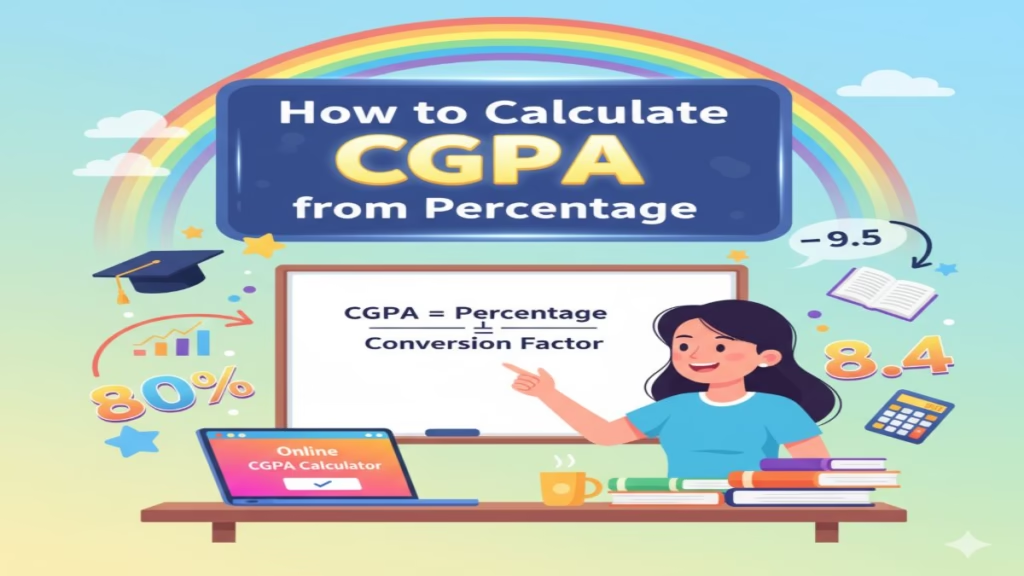
The key to learning how to calculate CGPA from percentage is the “conversion factor.” This is a number set by your university or college. It acts as the bridge between the percentage system and the CGPA scale. You will use this factor to convert your percentage marks into grade points. Different institutions and different grading scales use different conversion factors.
Common Conversion Factors
The conversion factor depends mainly on the maximum grade point your institution uses. This is often a 10-point scale or a 4-point scale.
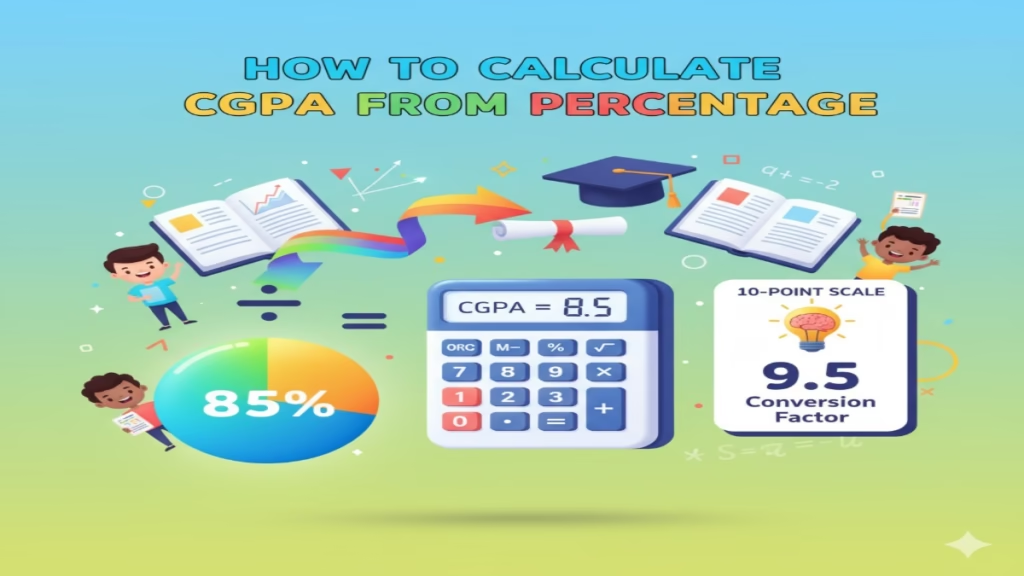
- For a 10-Point Scale: The widely used factor is 9.5. This means you divide your percentage by 9.5 to get your CGPA. For example, 90% is
CGPA.
- For a 4-Point Scale: The common factor is 5. If your university uses a 4-point scale, you usually divide your percentage by 5. For example, 80% is
. Wait, that’s too high! This particular division is often used for percentage equivalents before it is normalized to a 4-point GPA. The most reliable method is to check your university’s official CGPA conversion chart. Sometimes, a simple multiplication or direct percentage to GPA converter is used for 4-point scales.
Step-by-Step Guide: How to Convert Percentage to CGPA
The process of converting percentage to CGPA is simple arithmetic. Follow these steps to calculate CGPA from marks or percentage. You will be able to convert percentage into grade point easily.
Step 1: Determine Your Institution’s Scale
First, you must know what your university uses. Is it a 10-point scale, a 4-point scale, or something else entirely?
- Check your university’s academic handbook.
- Look at your past mark sheets or transcript.
- Confirm the maximum possible CGPA score.
This is the foundational step. It ensures you use the correct formula.
Step 2: Identify the Official Conversion Factor
Next, find the specific conversion factor your institution has officially set. This is crucial. Even among universities using a 10-point scale, the factor can sometimes be slightly different from 9.5.
- Where to find it: Usually on the official university website.
- Look for terms: “Grade Conversion Policy” or “CGPA Calculation Rules.”
Relying on a general factor like 9.5 without checking might lead to an inaccurate result.
Step 3: Apply the Formula
Once you have your percentage and the conversion factor, apply the simple percentage to CGPA formula.
- Formula:

Example on a 10-Point Scale (using 9.5 factor):
- If your Percentage is 85%.
- CGPA=85÷9.5
- CGPA≈8.95
This calculation shows how to calculate CGPA manually.
Different Conversion Scenarios Explained
While the division method is common, especially for 10-point scales, other methods exist. These methods depend on the specific CGPA grading system in place.
Percentage to CGPA for 10-Point Scale
This is the most common scenario, especially in India and many Asian countries. The standard percentage to CGPA formula is dividing by 9.5.
- Why 9.5? The factor of 9.5 is often used to ensure grade inflation is limited. It provides a slightly lower CGPA for a given percentage compared to a straight division by 10.
Another Example:
- If you scored 65%.
- CGPA=65÷9.5
- CGPA≈6.84
This method is reliable, but remember to always verify the factor.
Percentage to CGPA for 4-Point Scale
Converting to a 4-point scale (often called GPA or Grade Point Average) is more complex. It’s common in the US and Canada.
- The Problem: Direct division by a single factor might not be accurate. The conversion often involves a CGPA conversion chart. This chart maps specific percentage ranges to specific Grade Points.
| Percentage Range | Letter Grade | Grade Point (4.0 Scale) |
| 93%−100% | A | 4.0 |
| 90%−92% | A- | 3.7 |
| 87%−89% | B+ | 3.3 |
| … | … | … |
To accurately convert marks into CGPA on a 4-point scale, you need to use this mapping system. You would find the equivalent Grade Point for each subject, then average those Grade Points. An online percentage to CGPA converter specific to a 4-point scale is highly recommended here.
Official Guidelines: The Most Important Step
It cannot be stressed enough: The most vital part of learning how to find CGPA using percentage is following the official guidelines. Your academic record must be calculated according to your institution’s rules. This prevents problems when submitting transcripts.
Why Official Guidelines Matter
- Acceptance: Only the official calculation will be accepted by other universities or potential employers.
- Accuracy: It eliminates guesswork. It tells you the exact percentage to CGPA formula to use.
- Variations: Some universities might use a conversion factor of 10, not 9.5, for a 10-point scale. This is a significant difference.
Always check the Registrar’s office or the official academic page. Look for the document detailing your university’s CGPA conversion chart.
Tools and Resources for CGPA Calculation
While knowing how to calculate CGPA manually is helpful, using digital tools can save time and reduce errors. These tools are especially useful for complex calculations.
CGPA Calculator Online
An online percentage to CGPA converter is the fastest way to get your result.
- Ease of Use: You simply input your percentage and the scale (e.g., 10-point). The tool then displays the CGPA.
- Caution: Ensure the online calculator uses the correct conversion factor for your school. A generic one might be wrong. Search for a specific university percentage to CGPA conversion tool if available.
CGPA from Percentage Calculator
A dedicated CGPA from percentage calculator app or website is also a good option.
- Features: These calculators often allow you to input grades for individual subjects. They can factor in credit hours, leading to a more precise CGPA calculation. This makes the CGPA calculation from percentage much easier.
These tools are useful for quick checks. However, remember the manual process to truly understand your CGPA vs percentage comparison.
Conclusion: Mastering Your university percentage to cGPA conversion
Calculating your CGPA from a percentage is a necessary skill for academic life. By following these steps, you can confidently calculate CGPA from percentage. Remember to always start by finding the official conversion factor from your institution. Use the percentage to CGPA formula to quickly get your results. Whether you choose to calculate it manually or use a handy CGPA calculator online, you are now equipped with the knowledge. You no longer need to wonder how to calculate CGPA step by step. This guide gives you the power to accurately represent your academic achievements.
Want to find every GPA and CGPA calculator in one convenient place? Explore our All GPA & CGPA Calculators page — your complete hub for accurate, easy-to-use tools that help you calculate semester GPA, cumulative CGPA, percentage conversions, and much more. It’s the simplest way to keep track of your academic performance in seconds!
This isn’t just another article—it’s a solution. Share it to your LinkedIn or class groups and become a source of valuable info.