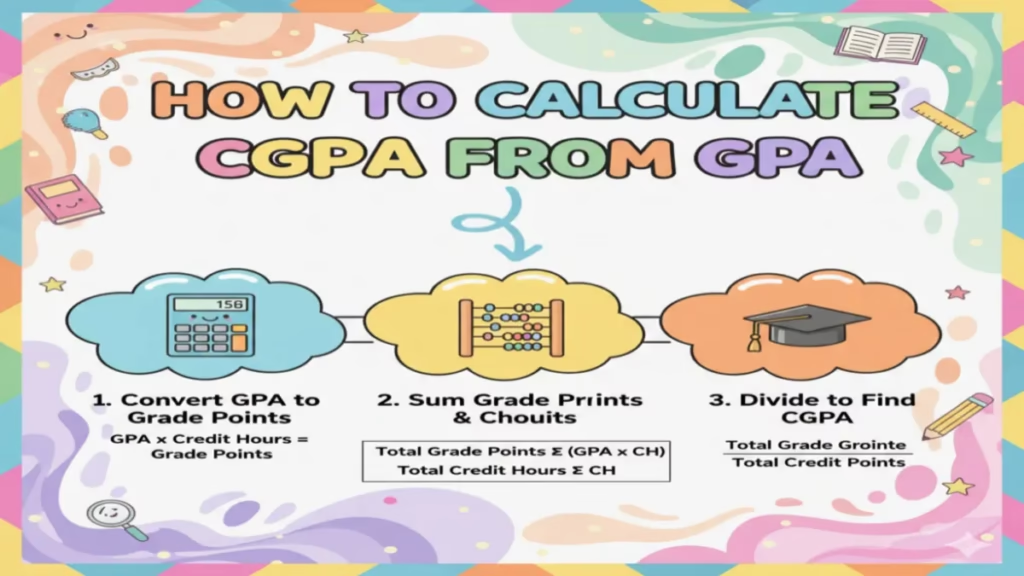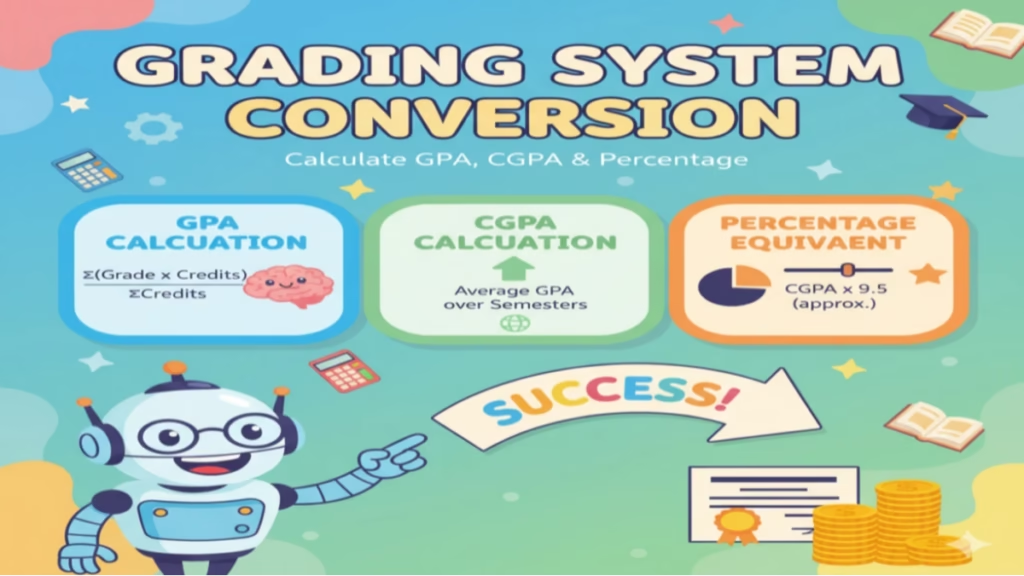
Navigating the university grading system in Pakistan can be confusing for many students. You often hear terms like GPA and CGPA, but what do they actually mean, and how are they determined? Understanding how to calculate GPA and CGPA in Pakistan is a fundamental skill for every student.
It is essential for tracking your academic performance and setting clear goals for each semester. This knowledge is not just for personal records; it is frequently required for scholarship applications, internship opportunities, and future job prospects.
This comprehensive guide is designed to demystify these concepts completely. We will break down everything into simple, easy-to-understand language. You will learn the clear difference between a semester’s GPA and your degree’s final CGPA.
We will also explore the common higher education grading scale used across the country. Furthermore, we will provide a detailed, step-by-step guide on performing these calculations yourself. By the end of this article, you will be able to compute your grades with confidence and take full control of your academic journey.
Understanding Pakistan’s Grading System
Furthermore, we will provide a step-by-step guide on how to calculate both your GPA and CGPA yourself. By the end of this article, you will be able to compute your grades with confidence.
What Exactly is a GPA?
Let’s start with the basics. GPA stands for Grade Point Average. Think of it as a snapshot of your academic performance in a single semester. It is a numerical representation of your overall grades for that specific term. For instance, after your Fall 2024 semester ends, the average of all the grades you earned in that period is your GPA.
It provides a quick and standard way to see how well you did. This is your semester marks conversion guide. Instead of looking at a list of individual subject grades, you can just look at your GPA. This single number gives a clear picture of your performance for that specific period. Therefore, it is a vital tool for a student performance analysis after each term.
And What Does CGPA Mean?
While GPA is for a single semester, CGPA has a broader scope. CGPA stands for Cumulative Grade Point Average. This is the most important number on your final degree transcript. It represents your overall academic performance throughout your entire degree program.
Essentially, your CGPA is the cumulative average of the GPAs you earned in every single semester of your study. For example, if your BBA degree is 4 years long and has 8 semesters, your CGPA will be the average of all 8 of your semester GPAs. It is the ultimate measure of your consistency and hard work. This cumulative grade point method gives a complete picture of your academic journey.
Understanding the University Grading System in Pakistan
Before you can calculate anything, you must understand the grading scale. Most universities in Pakistan use a scale of 4.0. In this system, each letter grade you get in a subject corresponds to a specific grade point.
Here is a common example of a university grading system in Pakistan:
- A = 4.0 (Excellent)
- B+ = 3.5 (Very Good)
- B = 3.0 (Good)
- C+ = 2.5 (Above Average)
- C = 2.0 (Average)
- F = 0.0 (Fail)
It is crucial to check your own university’s handbook. Some institutions might use a slightly different scale. For instance, some may include an A+ grade worth 4.0. Knowing your specific higher education grading scale is the first step to accurate calculation.
The Building Blocks: Credit Hours and Grade Points
Two key components are needed for any academic performance calculator Pakistan style: Credit Hours and Grade Points.
Credit Hours
Each course or subject you study is worth a certain number of credit hours. Think of them as the “weight” or “value” of that course. A difficult, main subject that has more classes per week will typically have 3 or 4 credit hours. An easier, minor subject might be worth 1 or 2 credit hours.
Grade Points
This is the point value you get for the letter grade you score in a course, as per the grading scale (e.g., an ‘A’ gives you 4.0 points). The final piece of the puzzle is the “Quality Point,” which we will calculate next.
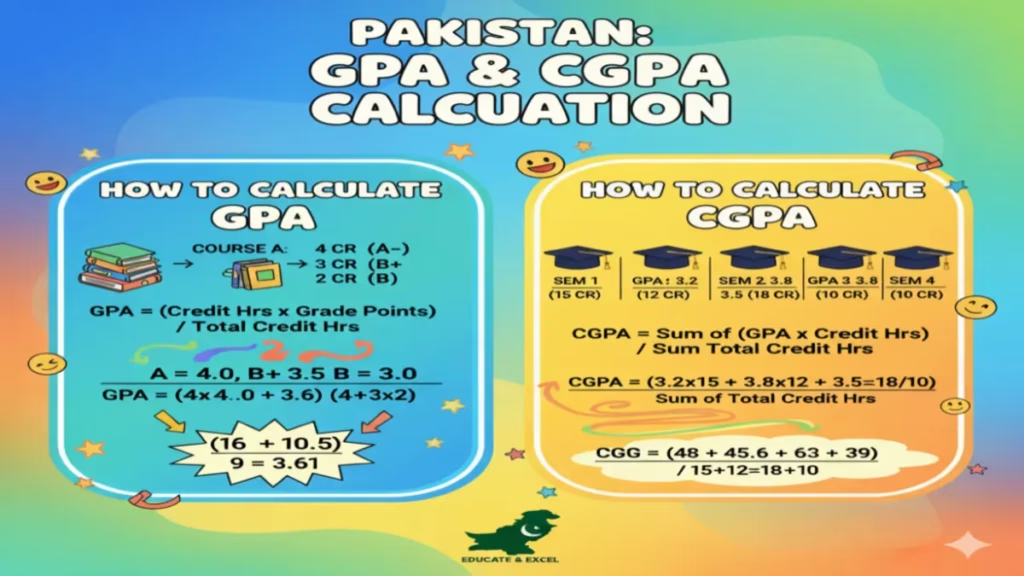
How to Calculate Your GPA: A Step-by-Step Guide
Calculating your GPA for one semester is a straightforward process. You can use this method as a simple student result evaluation tool. Let’s break it down with an example.
Imagine a student, Ali, has the following results for his first semester:
- Subject 1 (3 credit hours): Grade A (4.0 points)
- Subject 2 (3 credit hours): Grade B (3.0 points)
- Subject 3 (2 credit hours): Grade B+ (3.5 points)
Step 1: Calculate Quality Points for Each Subject.
Multiply the grade points by the credit hours for that subject.
- Subject 1: 4.0 grade points × 3 credit hours = 12 quality points
- Subject 2: 3.0 grade points × 3 credit hours = 9 quality points
- Subject 3: 3.5 grade points × 2 credit hours = 7 quality points
Step 2: Find the Total Sums.
Add all the credit hours together. Then, add all the quality points together.
- Total Credit Hours: 3 + 3 + 2 = 8
- Total Quality Points: 12 + 9 + 7 = 28
Step 3: Calculate the GPA.
Divide the total quality points by the total credit hours.
- GPA = Total Quality Points / Total Credit Hours
- GPA = 28 / 8 = 3.5
So, Ali’s GPA for the semester is 3.5 on a 4.0 scale. This subject-wise grade computation gives you a precise average for the term.
How to Calculate Your CGPA: The Big Picture
Now, let’s move to the cumulative grade point method for your CGPA. This calculates your overall average across all semesters. The process is similar to calculating GPA, but on a larger scale. You treat each semester’s GPA as a “grade” and its total credit hours as the “weight.”
Let’s continue with Ali’s example. Suppose his results for two semesters are:
- Semester 1: Total Credit Hours = 15, GPA = 3.2
- Semester 2: Total Credit Hours = 16, GPA = 3.6
Step 1: Convert Semester GPA to Total Quality Points.
For each semester, multiply the semester’s GPA by the total credit hours for that same semester.
- Semester 1: 3.2 GPA × 15 credit hours = 48 quality points
- Semester 2: 3.6 GPA × 16 credit hours = 57.6 quality points
Step 2: Find the Cumulative Totals.
Add the credit hours and quality points from all semesters.
- Cumulative Total Credit Hours: 15 + 16 = 31
- Cumulative Total Quality Points: 48 + 57.6 = 105.6
Step 3: Calculate the CGPA.
Divide the cumulative total quality points by the cumulative total credit hours.
- CGPA = Cumulative Total Quality Points / Cumulative Total Credit Hours
- CGPA = 105.6 / 31 = 3.41
Therefore, Ali’s CGPA after two semesters is 3.41. This final semester average calculation is what appears on your degree.
Converting CGPA to a Percentage
Many job applications or further study opportunities ask for a percentage. Fortunately, converting your CGPA to a percentage is very simple. A common and widely accepted formula is used as an overall grade percentage formula.
The Standard Conversion Formula:
Percentage = (CGPA / 4.0) × 100
Let’s use Ali’s CGPA of 3.41.
- Percentage = (3.41 / 4.0) × 100
- Percentage = 0.8525 × 100 = 85.25%
So, a CGPA of 3.41 translates to approximately 85.25%. This simple academic record tracker step makes it easy to fill out forms that require a percentage score.
Why Your GPA and CGPA Really Matter
Your grades are more than just numbers on a transcript. They are a key indicator of your learning and dedication. A strong CGPA opens many doors. Firstly, it is critical for securing admissions in prestigious universities for master’s programs, both locally and internationally.
Secondly, many top employers use CGPA as a filtering criterion during their recruitment process. It demonstrates a candidate’s consistency and ability to grasp complex concepts. Furthermore, most scholarships, especially merit-based ones, have a minimum CGPA requirement. Therefore, maintaining a good CGPA is directly linked to your academic and career funding.
Pro Tips to Improve Your Academic Score
Now that you know how to calculate GPA and CGPA in Pakistan, here are some tips to improve them.
- Understand the Weight: Focus more on subjects with higher credit hours. Scoring well in a 4-credit course will boost your GPA more than a 1-credit course.
- Consistency is Key: Don’t rely on a single semester. Consistent effort across all semesters is the only way to maintain a high CGPA.
- Use an Academic Performance Calculator: Create a simple spreadsheet to track your grades and predict your GPA/CGPA. This acts as your personal college score calculation Pakistan tool.
- Seek Clarification Early: If you don’t understand a topic, ask your teacher immediately. Letting doubts accumulate can harm your final exam performance.
- Review Past Papers: Practicing with past exam papers helps you understand the paper pattern and important topics.
Conclusion: Take Control of Your Academic Journey
Understanding how to calculate GPA and CGPA in Pakistan is a fundamental skill for every student. It empowers you to take charge of your own academic progress. You are no longer in the dark about how your final score is determined. This guide has provided you with a clear, step-by-step university result calculator Pakistan methodology.
Remember, the goal is not just to compute a number but to use that knowledge to strive for better performance. Use these calculations to identify your strengths and areas for improvement. Keep track of your progress each semester. With consistent effort and a clear understanding of the total academic average formula, you can achieve the academic excellence you desire.
“Once you calculate your GPA, you can use our CGPA to GPA Calculator“. Alternatively, move all tool links to a “All GPA & CGPA Calculators“