
Understanding your academic standing is key to a successful student life. You’ve likely heard the terms GPA and CGPA, and while they both measure performance, they have very distinct meanings and uses. Grasping the fundamental difference between GPA and CGPA is essential for tracking your progress, applying for scholarships, and planning your future career.
difference between gPA and CGPA
In short, one gives you a single snapshot, while the other provides the whole movie. This article will offer a detailed GPA vs CGPA comparison, explaining the scope, calculation, and purpose of each metric. By the end, you’ll have a clear understanding of your academic transcript and know why both are important measures of your hard work.
Understanding GPA: Your Semester Report Card
Let’s start with the simpler of the two: the Grade Point Average, or GPA
The Grade Point Average (GPA) serves as a short-term academic measure. Think of it as a progress report for a specific academic term. It reflects how well you performed in the courses you took during that single semester.
Consequently, a strong GPA indicates excellent performance right now, within the current period. It’s the most immediate feedback you receive on your academic efforts.
Scope and Focus of GPA
The scope of the GPA is strictly limited to one semester or a defined academic period.
- Short-Term Focus: It does not include any previous or future academic work. It’s solely about the classes just completed.
- Immediate Feedback: This metric helps you quickly assess your current standing. If you had a tough semester, your GPA will be lower, signaling an immediate need for improvement.
- Tracking Improvement: By looking at your GPA from one semester to the next, you can easily track whether your study habits are improving or declining.
How is GPA Calculated?
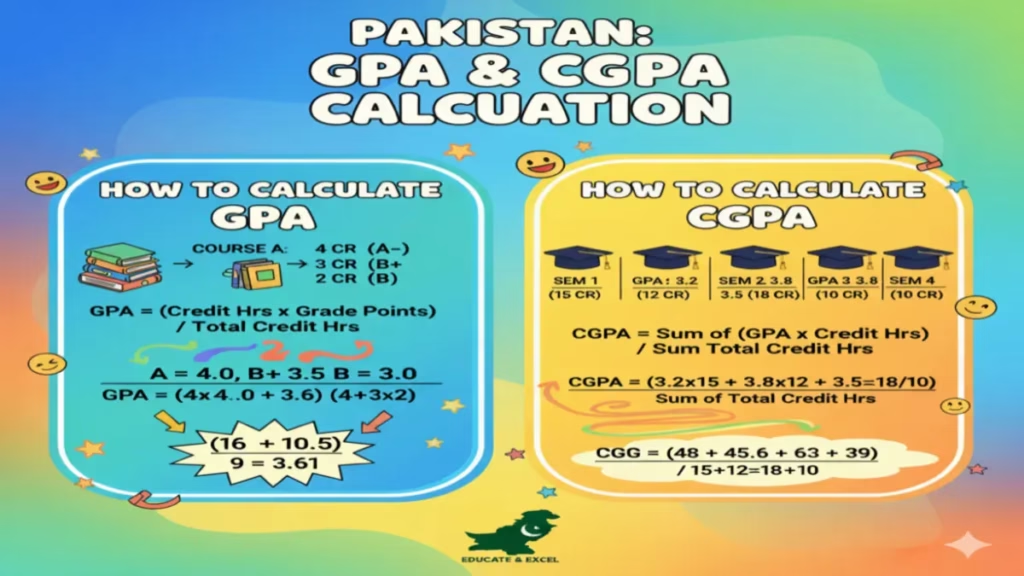
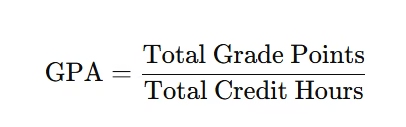
GPA (Grade Point Average) is calculated by converting your grades (like A, B, C, etc.) into grade points, multiplying each by the credit hours of the course, and then dividing the total grade points by the total credit hours.
Here’s the basic GPA formula:
🔹 Step-by-Step GPA Calculation Example:
- List your courses with their credit hours and grades.
Example:
| Course | Credit Hours | Grade | Grade Point |
|---|---|---|---|
| English | 3 | A | 4.0 |
| Math | 4 | B+ | 3.5 |
| Science | 2 | B | 3.0 |
- Multiply each course’s grade point by its credit hours:
- English → 3 × 4.0 = 12.0
- Math → 4 × 3.5 = 14.0
- Science → 2 × 3.0 = 6.0
- Add up all grade points:
12.0 + 14.0 + 6.0 = 32.0 - Add up total credit hours:
3 + 4 + 2 = 9 - Divide total grade points by total credit hours:
32 ÷ 9 = 3.56 GPA
🔹 Common U.S. Grade Point Scale:
| Letter Grade | Grade Point |
|---|---|
| A | 4.0 |
| A− | 3.7 |
| B+ | 3.3 |
| B | 3.0 |
| B− | 2.7 |
| C+ | 2.3 |
| C | 2.0 |
| D | 1.0 |
| F | 0.0 |
Understanding CGPA: Your Overall Academic Legacy
Now, let’s look at the bigger picture with Cumulative Grade Point Average, or CGPA.
In contrast to the GPA, the Cumulative Grade Point Average (CGPA) offers a comprehensive, long-term view of your academic performance. It is a holistic measurement that averages your performance across all the semesters you have completed throughout your entire degree program.
It shows consistency and sustained effort. Therefore, the CGPA is often seen as a more significant and reliable indicator of your overall capability.
Scope and Purpose of CGPA
The CGPA’s scope is all-encompassing, covering your entire time in the program. This makes it a crucial metric for future planning.
- Long-Term Assessment: It is a single, unified number that sums up your academic success from day one to the present.
- Demonstrates Consistency: A high CGPA proves that you maintain high standards over extended periods, not just for a single semester.
- Critical for Future Goals: This number is the main benchmark used by external bodies. It is required for graduate school admissions, professional certifications, and many job applications.
How is CGPA Calculated?
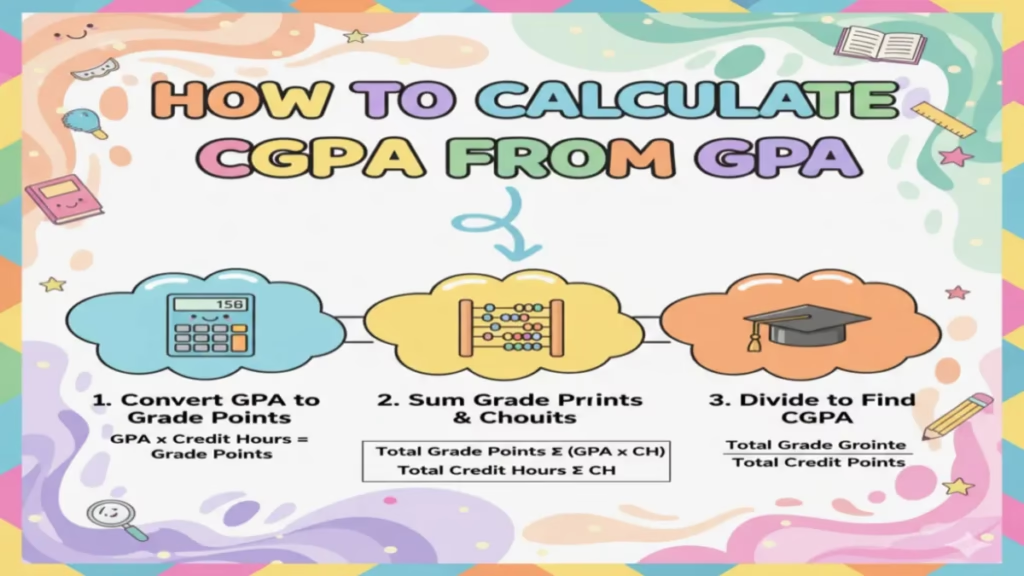
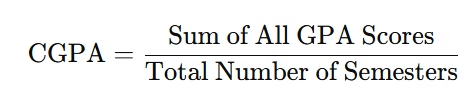
CGPA (Cumulative Grade Point Average) is the overall average of your GPA scores from all semesters or academic terms. It represents your academic performance across your entire course — not just a single semester.
CGPA Calculation Formula
🔹 Step-by-Step CGPA Calculation Example
Let’s say you have the following GPA scores from 4 semesters:
| Semester | GPA |
|---|---|
| 1st | 3.4 |
| 2nd | 3.6 |
| 3rd | 3.8 |
| 4th | 3.2 |
Step 1: Add all GPA scores
3.4 + 3.6 + 3.8 + 3.2 = 14.0
Step 2: Divide by the total number of semesters
14.0 ÷ 4 = 3.5
✅ Your CGPA = 3.5
🔹 Key Points to Remember
- GPA = Average grade points of one semester
- CGPA = Average of all semester GPAs
- CGPA gives a complete academic picture over the entire course.
difference between gpa and cgpa
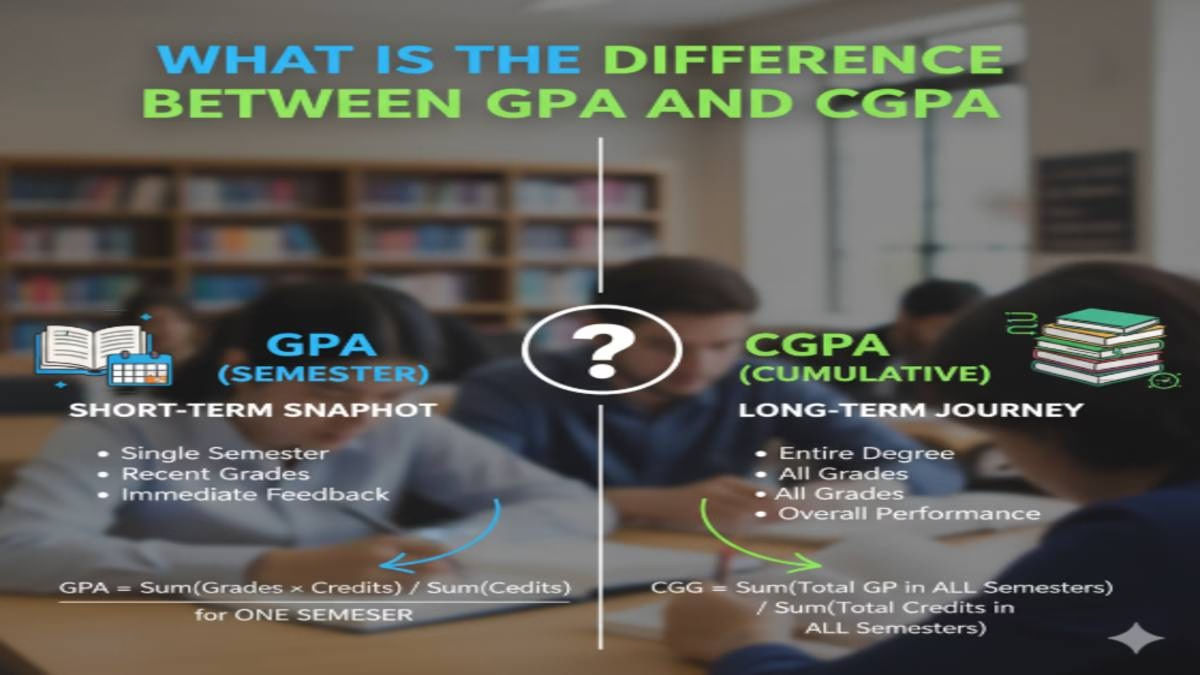
The main point of distinction between these two academic metrics lies in their timeframe and application.
GPA vs. CGPA: A Complete Comparison
GPA vs CGPA: Complete Comparison
Understanding the key differences in every aspect
| Aspect of Comparison | GPA (Grade Point Average) | CGPA (Cumulative Grade Point Average) |
|---|---|---|
| Definition & Scope | A measure of academic performance for a single term (e.g., semester or quarter). | A measure of the overall academic performance across the entire program or course. |
| Timeframe | Short-term. Calculated at the end of a specific semester or academic session. | Long-term. Calculated for the entire duration of a degree program (e.g., 4 years of college). |
| What it Represents | Your performance in a limited period. It can fluctuate significantly from term to term. | Your consistent academic performance and mastery over the long run. |
| Calculation |
Formula: GPA = Total Grade Points (for semester) ÷ Total Credit Hours (for semester) Example: 40 grade points ÷ 15 credit hours = 3.33 GPA |
Formula: CGPA = Total Grade Points (all semesters) ÷ Total Credit Hours (all semesters) Example: 300 grade points ÷ 100 credit hours = 3.00 CGPA |
| Impact & Usage |
• Dean’s List eligibility • Academic probation • Semester-specific scholarships • Internal performance tracking |
• Graduation honors (Cum Laude) • Job applications • Graduate school admissions • Major scholarships |
| Flexibility | More flexible. A low GPA can be compensated by high GPA in next semester. | Less flexible. Poor semesters have lasting (though diminishing) impact. |
| Interdependency | GPA is the building block for CGPA. | CGPA is the final result of all GPAs combined. |
| Common Scale | Typically on a 4.0 scale (A=4, B=3, C=2). Varies by country. | Almost always on the same scale as GPA (e.g., 4.0 scale). |
| Which is More Important? | Important for interim assessment during your program. | Generally carries more weight for final outcomes and opportunities. |
🎯 Key Takeaways
GPA = Single Chapter
Tells you how good that specific part of your academic story is.
CGPA = Entire Book Review
Summarizes the overall quality and consistency of your complete academic journey.
Your CGPA is the ultimate reflection of your academic career, built semester by semester through your individual GPAs.
Key Takeaway
- Think of GPA as a single chapter in a book. It tells you how good that specific part is.
- Think of CGPA as the entire book’s summary or review. It tells you the overall quality and consistency of the whole story.
Your CGPA is the ultimate reflection of your academic career, built semester by semester through your individual GPAs.
A Head-to-Head Comparison: GPA vs CGPA
To make the distinction crystal clear, let’s put them side-by-side. This GPA vs CGPA overview will highlight the key differentiators.
Scope and Timeframe
This is the most fundamental difference.
- GPA has a narrow scope. It is confined to one semester or term. It answers the question, “How did I do this semester?”
- CGPA has a wide scope. It encompasses your entire program, from start to finish. It answers the question, “How have I done throughout my degree?”
Purpose and Importance
Both scores are important, but they serve different purposes.
- GPA is crucial for short-term goals. A good semester GPA might get you on the Dean’s List, help you secure a semester-specific scholarship, or serve as a warning to improve your studies next term.
- CGPA is critical for long-term prospects. Universities for higher studies and most employers look at your CGPA. It demonstrates your consistent academic capability and work ethic over years, not just months.
Flexibility
Your GPA can fluctuate significantly from one semester to another. A bad semester can be balanced by a great one.
- Your CGPA is more stable and harder to change quickly. A single excellent semester will only nudge a low CGPA slightly, which is why consistent performance is key.
Which One is More Important?
The question of GPA vs CGPA which is better is common. The truth is, both are important for different reasons.
Think of it this way: you need a strong semester GPA to build a strong overall CGPA. You cannot have a high CGPA without consistently good GPAs. Therefore, you should focus on achieving the best possible GPA every single semester. This consistent effort is what will lead to an impressive CGPA upon graduation.
For your future, your CGPA often carries more weight. When you apply for a job or a master’s degree, the recruiter or admissions committee wants to see your overall performance. Your CGPA provides that holistic view. It shows your ability to sustain effort and succeed over the long haul.
A Practical Example to Illustrate the Difference
Let’s imagine a student named Anna in a four-year degree program.
- Year 1, Semester 1: Anna earns a GPA of 3.2. At this point, her CGPA is also 3.2, as it’s her only semester.
- Year 1, Semester 2: She improves and earns a GPA of 3.5. Her CGPA is now the average of her first two semesters, which might be 3.35.
- Year 2, Semester 1: Anna has a tough semester and her GPA drops to 2.8. This will pull her CGPA down, but not as drastically as it dropped for that single semester.
This example shows how a GPA can go up and down, while the CGPA changes more slowly, reflecting the cumulative trend.
Conclusion: difference between cGPA and gPA
In summary, GPA and CGPA are not rivals. They are two interconnected metrics that tell different parts of your academic story. Your GPA is the chapter, and your CGPA is the whole book. Understanding the difference between GPA and CGPA with example helps you set realistic goals. Focus on doing well in each semester to build a strong cumulative record. Keep track of both scores. Use them to monitor your progress and steer your academic career toward success. Remember, every semester is a new opportunity to improve your narrative.