
GPA to CGPA Calculator – Convert Your GPA Easily
Our GPA to CGPA Calculator simplifies this process by converting your marks / grades into a clear CGPA using standard grading logic.
Welcome to our GPA to CGPA Calculator
Understanding your academic performance can sometimes feel confusing, especially when different universities and colleges use different grading methods. This is where a GPA to CGPA Calculator becomes extremely helpful. GPA (Grade Point Average) represents your marks or grades for a single semester, while CGPA (Cumulative Grade Point Average) shows your overall cumulative score across multiple semesters or an entire academic program. Since most institutions follow a structured academic grading system, students often need an accurate way to convert their GPA into CGPA.
GPA to CGPA Calculator
Calculate your Cumulative Grade Point Average simply and accurately.
Whether your institution follows a semester system or an annual system, CGPA is calculated by combining GPA values with assigned credit hours for each subject. These calculations reflect your total academic performance and appear on your official transcript, making them important for scholarships, admissions, and job applications. Different universities apply their own university grading scale or college grading system, which can sometimes make manual calculation confusing.
It also helps students understand how the percentage system connects with GPA and CGPA, ensuring accuracy and clarity. Instead of struggling with formulas, this tool allows you to quickly calculate your CGPA and better track your academic progress with confidence.
Grades are more than just numbers. They represent effort, progress, and future opportunities. Many students struggle to understand how their results are measured across systems.
A CGPA Calculator helps convert grades into a clear format that universities and institutions understand. A GPA Calculator works in a similar way but focuses on semester-based results.
This online CGPA tool is useful for students, universities, and those planning to study abroad. It delivers fast results with high accuracy and removes manual calculation errors.
The GPA to CGPA calculator supports common grading systems and allows flexible input. You can enter data semester by semester and get results instantly.
The CGPA calculation tool supports 4.0, 5.0, and 10.0 scales. It allows multiple entries for each semester GPA and considers credit hours for precise calculation.
The system is designed to give an accurate result within seconds, making it suitable for both local and international academic needs.
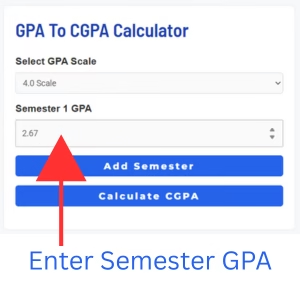
Enter Semester GPAs
GPA to CGPA Calculator
Cumulative GPA tool
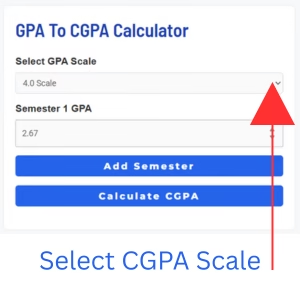
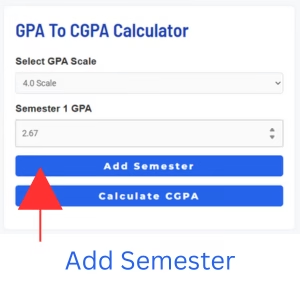
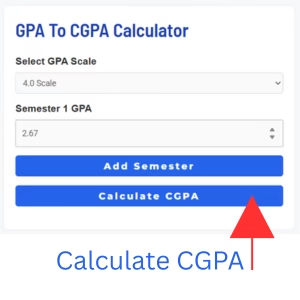
how to use GPA to CGPA Calculator
What is CGPA?
What is CGPA is a common question among students.
CGPA is the overall average of grades earned across all completed semesters. Its full form is Cumulative Grade Point Average.
It reflects long-term academic performance rather than results from a single term. Universities use it to assess consistency, discipline, and progress.
CGPA is widely used in the university grading system, academic transcripts, scholarships, and degree classifications.
Key Features of CGPA
Think of your CGPA as the grand summary of your entire academic journey. Unlike a GPA, which is a snapshot, your CGPA is the entire movie.
Here’s what makes it unique:
1. It’s Cumulative
This is the most important feature. CGPA stands for Cumulative Grade Point Average. It doesn’t just look at one semester. It calculates the average of your performance across all your semesters or terms in a program. It’s your overall academic track record.
2. It Gives a Complete Picture
Because it includes every semester, your CGPA provides a much broader and more complete view of your consistency and long-term performance than a single semester’s GPA ever could. A high CGPA shows you’ve been a steady and dedicated student throughout your course.
3. It’s Dynamic
our CGPA isn’t a fixed number. It changes with every new semester’s results. A strong performance in your final year can pull up a lower CGPA from your first year, and vice-versa. It’s a running tally of your success.
4. It’s Crucial for Future Opportunities
Your CGPA is often the first thing universities look at for master’s degree applications and what many companies scrutinize during campus placements or new-grad hiring. It serves as a standard, quick-reference metric to compare students from the same institution.
5. It’s Standardized
The CGPA system provides a uniform grading scale, often on a 4.0 or 10-point scale. This helps in creating a fair playing field within an institution and makes it easier for other organizations to understand your academic standing, even if they are from a different country or educational background.
What is GPA?
What is GPA refers to a semester-based grading method.
GPA measures performance for a specific academic term. It focuses on individual courses completed within one semester.
Unlike CGPA, it does not represent the full academic journey. GPA is calculated using a defined GPA scale, which varies by institution.
This method helps students track progress in each semester GPA separately.
Key Features of GPA:
Your Grade Point Average is more than just a number. It’s a structured system with several defining characteristics.
1. It’s a Standardized Measure
GPA provides a common language for academic performance. Whether you’re a student in the US on a 4.0 scale or in India on a 10.0 scale, it converts diverse letter grades into a uniform number. This allows for a fairer comparison between students taking different courses.
2. It’s Term-Specific
This is its most crucial feature. Your GPA is a snapshot of your performance for a specific period—typically a single semester, trimester, or academic year. It reflects how you did in that specific set of courses, not your entire academic career.
3. It’s Credit-Weighted
Not all courses affect your GPA equally. A grade in a 4-credit science lab has a bigger impact than a grade in a 1-credit workshop. The GPA calculation considers the “weight” (credit hours) of each course, making the final average a more accurate reflection of your effort and achievement.
4. It’s Dynamic and Changes Frequently
Because it’s tied to a single term, your GPA is fluid. It can go up or down each semester based on your new grades. This allows you to track your progress and improve over time.
5. It’s a Primary Academic Benchmark
GPA is often the first thing colleges, scholarship committees, and internship programs look at. It serves as a quick, initial filter to gauge a student’s consistency, work ethic, and mastery of the material.
6. It’s Calculated on a Scale
The GPA always exists within a defined scale, the most common being the 4.0 scale in the US. Other scales, like 5.0 or 10.0, are used in different parts of the world. The scale sets the upper and lower limits for the score.
The Main Steps to Raise Your GPA
Of course. Raising your GPA is a strategic process that requires consistent effort and a proactive approach. Here are the main steps to effectively raise your GPA, broken down into a clear action plan.
1. Diagnose and Analyze Your Current Situation
You can’t fix what you don’t measure. This is the most critical first step.
- Calculate Your Current GPA Precisely: Know exactly where you stand.
- Run a “GPA Scenario Analysis”: Use your GPA calculator to see what grades you need in future courses to reach your target. This tells you if you need consistent B’s, A’s, or A’s.
- Identify Problem Areas: Review your transcript. Are there specific courses dragging you down? Did you struggle in a particular subject area?
2. Master the Art of Planning and Organization
Success is built on a foundation of good habits.
- Use a Planner/Digital Calendar: Map out your entire semester. Record all major assignment due dates, exam periods, and project milestones at the start.
- Break Down Large Tasks: A big research paper is less daunting when you schedule smaller, manageable steps (research, outline, first draft, etc.).
- Create a Weekly Study Schedule: Dedicate specific, non-negotiable time blocks for each class, treating them like important appointments.
3. Optimize Your Course Performance
Be strategic about how you earn your grades.
- Prioritize by Weight: Focus more energy on assignments and exams that are worth a larger percentage of your final grade.
- Aim for Consistent, High Grades: It’s mathematically easier to maintain an A than to dig out of a C. Consistent effort from day one prevents last-minute scrambling.
- Never Miss an Assignment: Turning in every single assignment, even small ones, protects your grade floor and shows consistent engagement.
4. Engage Actively in Your Learning
Shift from a passive to an active learner.
- Go to Class & Participate: Attending class is the bare minimum. Actively listening, asking questions, and taking good notes dramatically improves retention.
- Leverage Professor Office Hours: This is a secret weapon. Clarifying concepts one-on-one can break down barriers and show your professor you’re invested.
- Form a Study Group: Teaching concepts to others is one of the best ways to solidify your own understanding.
5. Seek Strategic Academic Support
There is no bonus for struggling alone.
- Use Campus Resources: Most colleges offer free tutoring centers, writing centers, and academic success workshops. Use them before you start falling behind.
- Improve Your Study Skills: If your methods aren’t working, learn new ones. Explore techniques like active recall, spaced repetition, and the Pomodoro technique.
6. Make Strategic Course Selections
Be smart about building your future schedule.
- Balance Your Course Load: Mix challenging courses with ones you know you can do well in. Avoid taking all your hardest classes in one semester.
- Consider Retaking Courses: If your school replaces grades, retaking a course you did poorly in can be one of the fastest ways to boost your GPA.
- Explore “GPA Boosters”: When possible, include one well-regarded, interesting course that has a reputation for being manageable to balance your workload.
Key Mindset Shifts
- Be Proactive, Not Reactive: Don’t wait for a bad midterm grade to start improving. Start strong from the first week.
- Focus on Understanding, Not Just Grades: When you truly learn the material, good grades become a natural byproduct.
- Be Patient and Persistent: Raising a GPA is a marathon, not a sprint. It requires consistent, semester-over-semester effort.
By following these steps, you move from simply hoping for a better GPA to actively managing and achieving it.
Difference Between GPA and CGPA
The comparison of GPA vs CGPA helps clarify their roles.
GPA shows short-term results, while CGPA reflects long-term consistency. One is semester-based, the other cumulative.
The difference between GPA and CGPA lies in scope and purpose. Both are essential for proper academic evaluation and are often used together by institutions.
- GPA = one term result
- CGPA = overall performance
How to Calculate CGPA (Step-by-Step)
Many students ask how to calculate CGPA correctly.
Start by listing all semester GPAs.
Next, note the credit hours for each subject.
Multiply each GPA by its credits.
Add all values to apply the weighted average GPA method.
Finally, divide by total credits using the CGPA calculation formula.
This method ensures fairness and accuracy.
How to Convert GPA to CGPA
Sometimes results must be unified across systems.
To convert GPA to CGPA, institutions consider the grading scale used. This process is known as GPA to CGPA conversion.
It is required when comparing results across different terms or universities. Manual calculations are possible, but automated tools are faster.
Most systems support GPA scale 4.0, 5.0, 10.0 for standardized conversion.
How to Convert CGPA to GPA
International universities often request GPA values.
A CGPA to GPA calculator simplifies this process. It helps convert CGPA to GPA accurately based on accepted standards.
A common case is 10-point CGPA to 4-point GPA, especially for foreign admissions.
Different countries follow different rules, so understanding the international grading scale is essential.
POPULAR GUIDES
How to Calculate Your Grade Point Average
GPA and CGPA Difference Explained
Looking for more tools? Explore our complete collection of GPA and CGPA tools on the GPA & CGPA Calculators hub.
Grading Systems by Country
Grading systems vary significantly around the world. Understanding how GPA to CGPA conversion works in different countries is crucial for international students, those applying to foreign universities, or anyone trying to understand their academic standing in a global context.
- United States GPA System
- United Kingdom Degree Classification
- Pakistan GPA & CGPA System
- India CGPA System
- Switzerland Grading System
- Canada GPA Scale
Important Considerations for International Conversion:
- University Variations: Always check with your specific institution as conversion methods can vary even within the same country
- Official Credential Evaluation: For important applications (like university admissions), use official credential evaluation services like WES or ECE
- Scale Differences: Be aware that a 3.5 GPA on a 4.0 scale means something different than a 3.5 on a 4.3 scale
- Credit Weighting: Some countries and universities weight courses by credit hours, while others don’t.
CGPA Conversion Table
| GPA (4.0) | 4.0 Scale | 5.0 Scale | 7.0 Scale | 10.0 Scale |
|---|---|---|---|---|
| 4.0 | 4.0 | 5.0 | 7.0 | 10.0 |
| 3.9 | 3.9 | 4.875 | 6.825 | 9.75 |
| 3.8 | 3.8 | 4.75 | 6.65 | 9.5 |
| 3.7 | 3.7 | 4.625 | 6.475 | 9.25 |
| 3.6 | 3.6 | 4.5 | 6.3 | 9.0 |
| 3.5 | 3.5 | 4.375 | 6.125 | 8.75 |
| 3.4 | 3.4 | 4.25 | 5.95 | 8.5 |
| 3.3 | 3.3 | 4.125 | 5.775 | 8.25 |
| 3.2 | 3.2 | 4.0 | 5.6 | 8.0 |
| 3.1 | 3.1 | 3.875 | 5.425 | 7.75 |
| 3.0 | 3.0 | 3.75 | 5.25 | 7.5 |
| 2.9 | 2.9 | 3.625 | 5.075 | 7.25 |
| 2.8 | 2.8 | 3.5 | 4.9 | 7.0 |
| 2.7 | 2.7 | 3.375 | 4.725 | 6.75 |
| 2.6 | 2.6 | 3.25 | 4.55 | 6.5 |
| 2.5 | 2.5 | 3.125 | 4.375 | 6.25 |
| 2.4 | 2.4 | 3.0 | 4.2 | 6.0 |
| 2.3 | 2.3 | 2.875 | 4.025 | 5.75 |
| 2.2 | 2.2 | 2.75 | 3.85 | 5.5 |
| 2.1 | 2.1 | 2.625 | 3.675 | 5.25 |
| 2.0 | 2.0 | 2.5 | 3.5 | 5.0 |
| 1.9 | 1.9 | 2.375 | 3.325 | 4.75 |
| 1.8 | 1.8 | 2.25 | 3.15 | 4.5 |
| 1.7 | 1.7 | 2.125 | 2.975 | 4.25 |
| 1.6 | 1.6 | 2.0 | 2.8 | 4.0 |
| 1.5 | 1.5 | 1.875 | 2.625 | 3.75 |
| 1.4 | 1.4 | 1.75 | 2.45 | 3.5 |
| 1.3 | 1.3 | 1.625 | 2.275 | 3.25 |
| 1.2 | 1.2 | 1.5 | 2.1 | 3.0 |
| 1.1 | 1.1 | 1.375 | 1.925 | 2.75 |
| 1.0 | 1.0 | 1.25 | 1.75 | 2.5 |
Frequently Asked Questions
Why Students Trust GPAtoCGPA.com
- Accurate calculation formulas
- Updated grading standards
- Free & easy to use
- Student-focused explanations
Calculate Your CGPA Now →