
CGPA To Percentage Calculator Out Of 4
Quickly Calculate Your Percentage: The Ultimate CGPA to Percentage Calculator Out of 4 for Engineering, University, and Job Applications.
CGPA to Percentage Calculator
Enter semester details to find your CGPA and equivalent Percentage.
Convert Your CGPA to Percentage Out of 4 Instantly
When you complete a degree, you often get a Cumulative Grade Point Average (CGPA). This score is typically on a 4.0 scale in many universities, especially in the USA and increasingly worldwide. You’ll need to know the equivalent percentage for job applications, further studies, or scholarship opportunities. This article is your detailed roadmap to confidently converting your CGPA to percentage out of 4 using the most common and accepted methods. We’ll cover the simple math, what your university may require, and why this conversion is so important.
What Exactly Are CGPA and Percentage?
Before we dive into the conversion, let’s clarify the two main grading systems.
CGPA stands for Cumulative Grade Point Average. It is a measure of your overall academic performance. The CGPA is calculated as the average of grade points you earned in all subjects. For example, a 4.0 scale is very common, where the highest possible score is a 4.0. This system is used in many countries, including the United States, Canada, and various institutions in India and the Middle East.
On the other hand, a percentage is a more straightforward metric. It represents the marks you obtained out of a total of 100. This system is very familiar to most students. The challenge arises when you need to translate your CGPA, which is on a different scale, into this percentage format. This conversion is essential for creating standardized academic records.
and Why Does it Matter?
CGPA, or Cumulative Grade Point Average, is a common metric that shows your academic performance throughout your entire course of study. Think of it as a weighted average of all your grades. It offers a standardized way for institutions to compare student performance. Many countries use a 4-point scale, where 4.0 is the highest score possible, often representing an ‘A’ grade or exceptional performance.
The Importance of Your Score
- Job Market: Employers use your CGPA to quickly assess your academic background and dedication. A high score can open doors to interviews.
- Higher Education: Applying for a Master’s or Ph.D. program? Your CGPA is one of the most critical factors for admission, alongside test scores and recommendations.
- Scholarships: Most academic scholarships have a minimum CGPA requirement. Converting your CGPA to percentage helps you meet application criteria.
The Standard Conversion Formula: Simple and Quick Math
The clearest and most widely used standard formula for converting a CGPA to a percentage out of 4.0 is:
Percentage=CGPA×25
Explanation
This formula is based on the assumption that a perfect score of 4.0 CGPA is equivalent to a perfect 100% grade.
- Calculation: 4.0×25=100%
Examples
| CGPA (Out of 4.0) | Calculation (×25) | Percentage Equivalent |
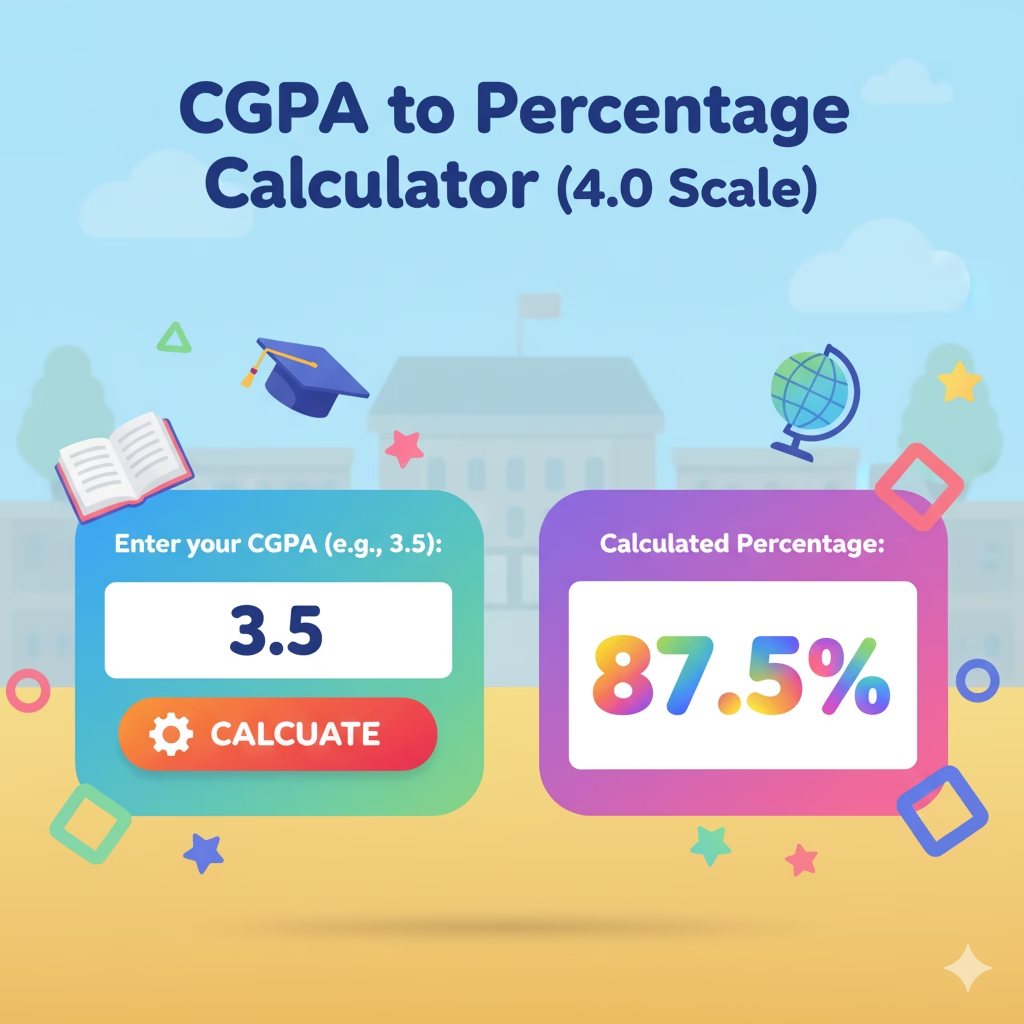
| 3.5 | 3.5×25 | 87.5% |
| 3.0 | 3.0×25 | 75.0% |
| 2.8 | 2.8×25 | 70.0% |
Important Note
While this is the standard, simple calculation, always check with your specific university or the institution receiving your application (e.g., a foreign university or employer). Many institutions use a different, non-linear conversion table or a slightly modified formula for official grade reporting. Always prioritize the official method provided by your academic institution.
CGPA to Percentage Calculator (4.0 Scale)
To make things even easier for you, here is a simple reference table. This table acts as a quick free online Cumulative GPA to percentage calculator 4.0 scale. You can use it to find your percentage without doing any math.
| CGPA (on 4.0 Scale) | Equivalent Percentage |
|---|---|
| 4.0 | 100% |
| 3.9 | 97.5% |
| 3.8 | 95% |
| 3.7 | 92.5% |
| 3.6 | 90% |
| 3.5 | 87.5% |
| 3.4 | 85% |
| 3.3 | 82.5% |
| 3.2 | 80% |
| 3.1 | 77.5% |
| 3.0 | 75% |
| 2.5 | 62.5% |
| 2.0 | 50% |
Understanding the Difference: CGPA vs. GPA
It is easy to confuse CGPA and GPA, but they are distinct academic measures. Understanding the difference is important for accurate conversions.
Grade Point Average (GPA)
- Definition: GPA is typically the average of grades achieved in a single term, semester, or academic year.
- Purpose: It gives you a snapshot of your performance during a limited study period.
Cumulative Grade Point Average (CGPA)
- Definition: CGPA is the average of grades achieved across all semesters or academic periods completed so far.
- Purpose: It represents your overall academic standing from the first day of your program to the present.
How International Standards Differ and Why Context Matters
Focus on the 4.0 Scale
Many international universities, particularly those in North America, use the 4.0 scale. Therefore, the standard multiplication by 25 is often an acceptable baseline. However, other systems exist. For example, some institutions in India use a 10-point scale. This scale requires multiplying the CGPA by 9.5 for conversion. Knowing the original scale is the first crucial step.
Regional Variations
It is important to look at specific regions. For example, the United Kingdom uses a classification system (First Class Honours, Upper Second Class, etc.). Their system is entirely different from the CGPA structure. Additionally, different US universities may have minor variations in their grading curves. The key takeaway is that conversions are context-specific. Always look for documentation from the receiving institution to ensure your application is processed correctly.
Practical Scenarios: When and Where You Need the Conversion
Applying for Graduate School
Most graduate schools require you to submit an official transcript. Consequently, if your school uses a CGPA system and the application demands a percentage, you must provide the correct equivalent. A mismatch could cause delays or rejection. The admissions committee needs a consistent metric for comparison.
Immigration and Visa Requirements
When applying for student or work visas, governmental bodies often require an official academic equivalency. They need to understand your educational attainment. Furthermore, some organizations use standardized external bodies to verify your degree. These bodies use established conversion charts. Making the conversion yourself ensures you are prepared for their process.
Professional Certifications
Some professional certification exams or licensing bodies require a minimum academic percentage. Hence, converting your CGPA is necessary to prove eligibility. For example, engineering or medical licensing boards often have strict academic entry requirements. Knowing your percentage helps you plan your professional trajectory.
The Pitfalls of Using Unofficial Conversion Methods
Risk of Misrepresentation
Using an unofficial or incorrect conversion formula can lead to misrepresenting your academic standing. Specifically, if you use the simple CGPA×25 when your university uses a non-linear chart, your percentage might be overstated or understated. This could be seen as dishonesty on an application.
Administrative Delays
If the receiving organization—be it an employer or a university—cannot verify your conversion, they will flag your application. This leads to time-consuming back-and-forth communication. Moreover, administrative delays can cause you to miss application deadlines. Always provide the officially sanctioned conversion table or method from your institution.
Final Steps: Verifying Your Converted Percentage
Consulting the Transcript
Your official academic transcript is the ultimate source of truth. Consequently, check if your transcript includes a conversion key or a note about the percentage equivalent. Many international transcripts provide both the CGPA and the calculated percentage.
Contacting the Registrar’s Office
If the transcript lacks a conversion key, the registrar’s office or the student records department is your next step. They are responsible for issuing official academic records. Ask them for the official conversion policy or a letter stating the percentage equivalency. This official documentation is usually required for formal applications.
Documenting the Method
When you submit your application, always state the conversion method you used. If you used the standard CGPA×25 formula, mention it clearly. On the other hand, if you used a university-specific table, reference the source of that table. Thus, you ensure transparency and accuracy in your submission.
Conclusion: 4 point cGPA to percentage conversion
In conclusion, converting your CGPA to a percentage doesn’t have to be a headache. By understanding the standard formula and, most importantly, knowing when to rely on your university’s specific rules, you can confidently present your academic scores in the required format. Remember, this guide and the simple cgpa to percentage formula for 4 point scale are here to help you take the next step in your academic or professional journey with confidence.
We hope this guide has been a valuable resource for you! If you need to convert other types of grades, we have a dedicated hub page that brings together all the tools you might need. To access all these tools in one convenient location, we highly recommend you visit our complete resource page: All GPA & CGPA Calculators in One Place.
Did you find this article helpful? If so, please help other students and professionals by liking and sharing it on your social media channels and university forums. Sharing knowledge makes the academic journey easier for everyone